On-shelf availability in FMCG: why "in the system" does not mean "on the shelf"
A product can be available in ERP, in the warehouse or even inside the store. But if the shopper cannot see it on the shelf at the moment of purchase, the sale is already at risk.
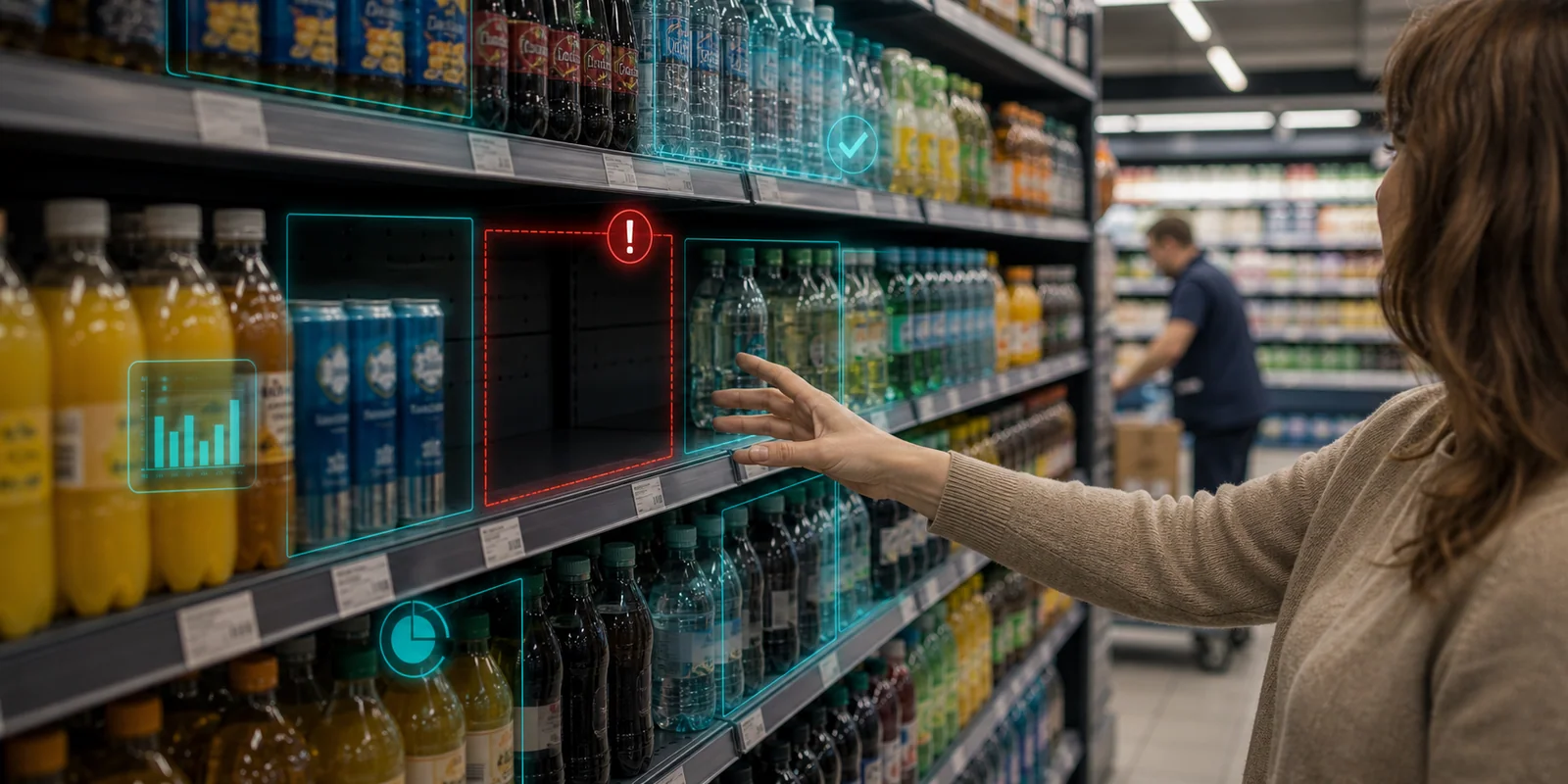
One of the most dangerous illusions in FMCG is that a product is available because the system says it is available.
ERP has units. The warehouse shipped. The distributor delivered. The store received the goods. On paper, everything looks fine.
But shoppers do not buy from ERP. They buy from the shelf.
If the product is not physically in the right place, visible, reachable and available at the right moment, it does not exist for the shopper. It does not matter if it is in the backroom. It does not matter if it is on a pallet in the store warehouse. It does not matter if it sits two meters away from the category. It does not matter if the system shows stock.
For the shopper, the empty space is the truth.
That is the meaning of on-shelf availability: not simply whether goods exist somewhere, but whether the customer can find and buy the product exactly when they are looking for it.
System availability vs shelf availability
Inventory availability and on-shelf availability sound similar, but they are different.
Inventory availability answers the question: do we have units in the system, warehouse, store or supply chain?
On-shelf availability (OSA) asks a stricter question: is the product physically on the shelf, in the right place, in sufficient quantity and accessible to the shopper?
The gap between the two is where FMCG loses a lot of money.
An SKU can be:
- available in the warehouse, but not delivered;
- delivered to the store, but left in the backroom;
- present in the store, but not replenished to the shelf;
- on the shelf, but in the wrong location;
- in the right location, but with too few facings;
- positive in system stock, but physically gone;
- available, but hidden behind a competitor product or a wrong label.
From an operations point of view these are different cases. From the shopper's point of view the result is the same: the product is missing.
Why OSA is more expensive than it looks
Out-of-stock is not a small operational mistake. It is a direct loss of sale, brand and trust.
The classic Corsten and Gruen study reports an average worldwide out-of-stock level of around 8.3%. That means roughly one in twelve items is not available to the shopper when they look for it. More important is the shopper response: some shoppers switch stores, some switch brands, some delay the purchase and some do not buy at all.
NielsenIQ frames the same problem clearly: empty shelves are not only a customer inconvenience, but a real loss for the FMCG industry. IHL Group treats inventory distortion - the combination of out-of-stocks and overstocks - as a trillion-dollar global retail problem.
The point is simple: shelf absence is not only a supply-chain issue. It is a commercial issue.
When a product is missing:
- the customer may buy a competitor product;
- they may go to another store;
- their loyalty to the brand may weaken;
- the promotion may fail;
- shelf space may be captured by a competitor;
- the business may think demand is low, while the product was simply not available.
The last point is especially dangerous. If the system only looks at sales, it may conclude that the product does not sell. Reality may be the opposite: the product does not sell because it is not on the shelf.
OSA is an execution KPI, not only a supply-chain KPI
Many companies treat OSA as part of supply-chain reporting. That is logical, but incomplete.
Yes, the cause can be upstream: forecast error, missing supply, weak safety stock, supplier failure or poor promotion planning.
But a large share of OSA failures happens inside the store or at the boundary between delivery and execution.
ECR Retail Loss describes a shelf out-of-stock as a situation where the item is theoretically in the store, but the shopper sees an empty space: the stock may be in the backroom, in the wrong location, in a cage, on a trolley, mis-shelved or simply not replenished in time.
That changes how we should think.
If the goods were not produced or delivered, supply chain must respond.
If the goods are in the store but not on the shelf, retail execution must respond.
If the order was wrong, the order-taking process must respond.
If the route did not visit the store in time, the route-to-market model must respond.
OSA is where these processes meet. That is why it cannot be solved by one dashboard alone.
How shelf availability breaks
OSA rarely breaks for one reason. Usually it is a chain of small failures.
Wrong order. The store orders "the usual", but the week is not usual. There is a promotion, seasonality, a local event, a traffic change or competitor pressure.
Insufficient visit frequency. The store has potential, but is visited too rarely. By the next cycle, the hero SKU is already gone.
Weak in-store replenishment. The goods arrived, but never moved from the backroom to the shelf.
Poor planogram or execution. The product is available, but not in the agreed location, without enough facings or hidden in the category.
Promotion peak. The promotion is planned on paper, but quantities, displays and replenishment frequency are not synchronized.
Inventory record inaccuracy. The system believes stock exists, but physically it does not. The replenishment order is not triggered when it should be.
No shelf signal. The manager sees the problem after the cycle ends, when the sale has already been lost.
Each of these causes requires a different action. That is why simply knowing there is an out-of-stock is not enough. You need to know what kind of out-of-stock it is.
Why classic reporting sees the issue too late
Classic reporting works backwards.
Sales fall. Somebody sees the decline. Then the team searches for a reason. Maybe demand is weak. Maybe the competitor gained share. Maybe the promotion did not work. Maybe the sales rep did not visit the outlet.
But if the real reason is an empty shelf, it is already late.
FMCG execution needs a signal while the problem can still be fixed:
- during the sales rep's visit;
- before the promotion peak;
- before the next route cycle;
- before the order is underestimated;
- before a competitor SKU takes the space.
That is why computer vision and AI matter for OSA. Not because they create attractive images with boxes. Because they create a new, direct signal from the physical shelf.
How computer vision changes OSA
Computer vision does not solve OSA by itself. But it provides something classic systems do not have: an objective view of the physical shelf.
A shelf image can show:
- whether the SKU is really present;
- how many facings it has;
- whether there is empty space;
- whether the product is in the right location;
- whether the label and price are visible;
- whether the promotional display is installed;
- whether a competitor captured agreed space.
That turns OSA from an assumption into a measurable signal.
But the real value appears when the signal is connected to action.
If a shelf scan shows that a hero SKU is nearly depleted, the system should do something:
- suggest an additional order;
- change the priority of the next visit;
- create a task for the sales rep;
- alert the manager;
- compare the issue with the promotion calendar;
- check whether this is a local issue or a pattern across many stores.
Computer vision is powerful not as recognition, but as a trigger for an execution loop.
How AI order taking closes the loop
OSA and AI order taking are more connected than they first appear.
If the shelf is empty, the next order should not be "the usual." It should consider:
- how many days remain until the next visit;
- how fast the SKU moves;
- whether there is a promotion;
- whether the gap is caused by demand or poor execution;
- whether the store is high-potential;
- whether there is shelf space;
- whether the warehouse can supply.
This makes suggested order the natural continuation of OSA analysis.
Example:
"Increase quantity for SKU A: shelf scan shows low availability, the last two orders ran out before the next visit, and the promotion starts Friday."
Or:
"Do not increase quantity for SKU B: the product is available in-store, but not in the right position. Restore shelf placement first."
That is the difference between AI that forecasts and AI that helps the sales rep make a better decision inside the store.
How route priority helps
Not every OSA issue deserves the same response.
If a small, low-potential outlet is missing a secondary SKU, that is a problem. But if a key store in a promotion week runs out of a hero SKU, that is an urgent commercial risk.
That is why OSA should feed route priority.
The route should not be geography only. It should combine:
- store potential;
- out-of-stock risk;
- category and SKU importance;
- promotion calendar;
- history of the issue;
- cost-to-serve;
- probability that the visit will change the outcome.
Then the sales rep does not simply visit "the next store in sequence." They visit the store where action has the highest chance of saving a sale.
How to measure OSA properly
OSA should not be measured only as an average percentage.
The average can hide what matters.
A better framework looks at several layers.
SKU-level OSA. Which exact products are missing, especially hero SKUs, must-stock list items and promotional articles.
Store-level OSA. Which stores systematically have a problem. That may point to weak replenishment, a weak rep, a poor route cycle or a poor partner.
Weighted OSA. A missing SKU in a store with high category potential matters more than the same issue in a small outlet. Just as weighted distribution is more honest than numeric distribution, weighted OSA is more honest than a flat average.
Promo OSA. Promotion periods should be measured separately. Missing stock is more expensive there because the company has already paid for mechanics, discount, display or trade spend.
Repeat OOS. A one-time gap is a problem. A repeated gap is a system defect.
Time-to-fix. How long it takes from detecting the issue to action. Classic reporting often misses this KPI.
Reason code. Why the product is missing: no supply, wrong order, backroom, shelf execution, planogram, promotion, inventory inaccuracy.
Without a reason code, OSA remains a symptom. With a reason code, it becomes a manageable process.
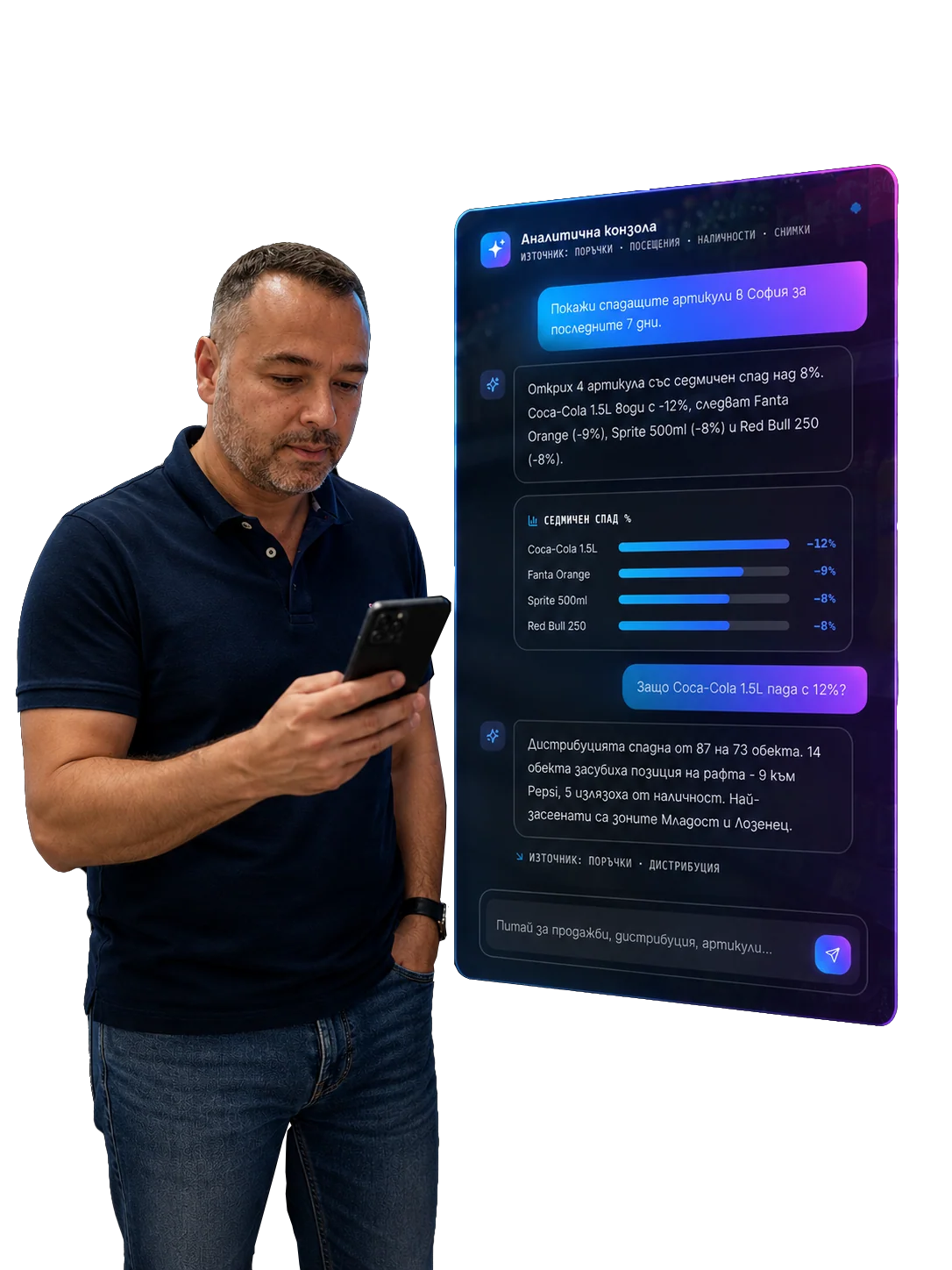
What the sales rep should see
The sales rep does not need another dashboard.
They need a short, precise signal:
- which SKU is at risk;
- why it is at risk;
- what to do now;
- how to explain it to the customer.
For example:
"Hero SKU is missing from the shelf. It was included in the last delivery. Check backroom and restore position."
Or:
"Promo SKU is below minimum shelf stock. Add 18 units to the order because the next visit is in 5 days."
Or:
"The category has space, but the must-stock SKU is absent. Propose adding it to the range."
This is operational intelligence, not just reporting.
What the manager should see
The manager needs a different view.
Not "how many photos were uploaded", but:
- which stores have the highest weighted OSA risk;
- which SKUs lose the most sales;
- where the issue is supply chain;
- where the issue is store execution;
- which reps fix the issue fast;
- which distributors have a systemic gap;
- which promotions fail because of availability;
- what the financial impact is.
If the manager sees only compliance, the system becomes a control tool.
If the manager sees impact, the system becomes a commercial tool.
The key point: OSA is not an image, it is a loop
It is easy to become fascinated by the technology.
Computer vision. Shelf cameras. AI models. Dashboards. Alerts.
But OSA is not fixed by an image. It is fixed by a loop:
- Detect the issue on the shelf.
- Understand the cause.
- Give the right action to the right person.
- Adjust the order, route or execution.
- Verify whether the issue was solved.
- Learn from repeated patterns.
If any step is missing, technology becomes an expensive detector. It sees the problem but does not close it.
In short
On-shelf availability is one of the most important FMCG KPIs because it measures the reality the shopper sees.
System availability is not enough. Warehouse availability is not enough. Delivery to the store is not enough.
The sale happens only when the product is on the shelf, visible, accessible and on time.
That is why OSA should be managed as an execution loop:
- computer vision provides the shelf signal;
- AI order taking translates the signal into a better order;
- route priority sends the rep to the right store;
- manager visibility shows causes and financial impact;
- governance keeps actions controlled.
The real question is not:
"Do we have it in the system?"
The real question is:
"Can the shopper take it from the shelf right now?"
If the answer is no, the sale is already at risk.
Related in Optimasoft
- Shelf computer vision explains how the image detects empty slots, facings and planogram gaps.
- The image recognition solution is the practical layer for detecting OSA/OOS issues in the field.
- AI Order Brain connects shelf signals to suggested orders when the gap comes from wrong quantity.
- Route optimization lets OSA risk influence the priority of the next visit.
Sources
- NielsenIQ - Can the FMCG industry afford to lose billions from empty shelves?
- Corsten & Gruen - Retail Out-of-Stocks: A Worldwide Examination of Extent, Causes and Consumer Responses
- ECR Retail Loss - On-shelf availability
- ECR Europe - Optimal Shelf Availability
- IHL Group - Inventory Distortion: The Good, The Bad, the Ugly
- NielsenIQ - Total Distribution Points and CPG brands
Related articles