Perfect Store: the measurable science behind 2-5% sales growth
Perfect Store is not a shelf checklist. It is an operating system for the whole outlet: the right assortment, the right zone, the right availability, the right promotion and action during the same visit.
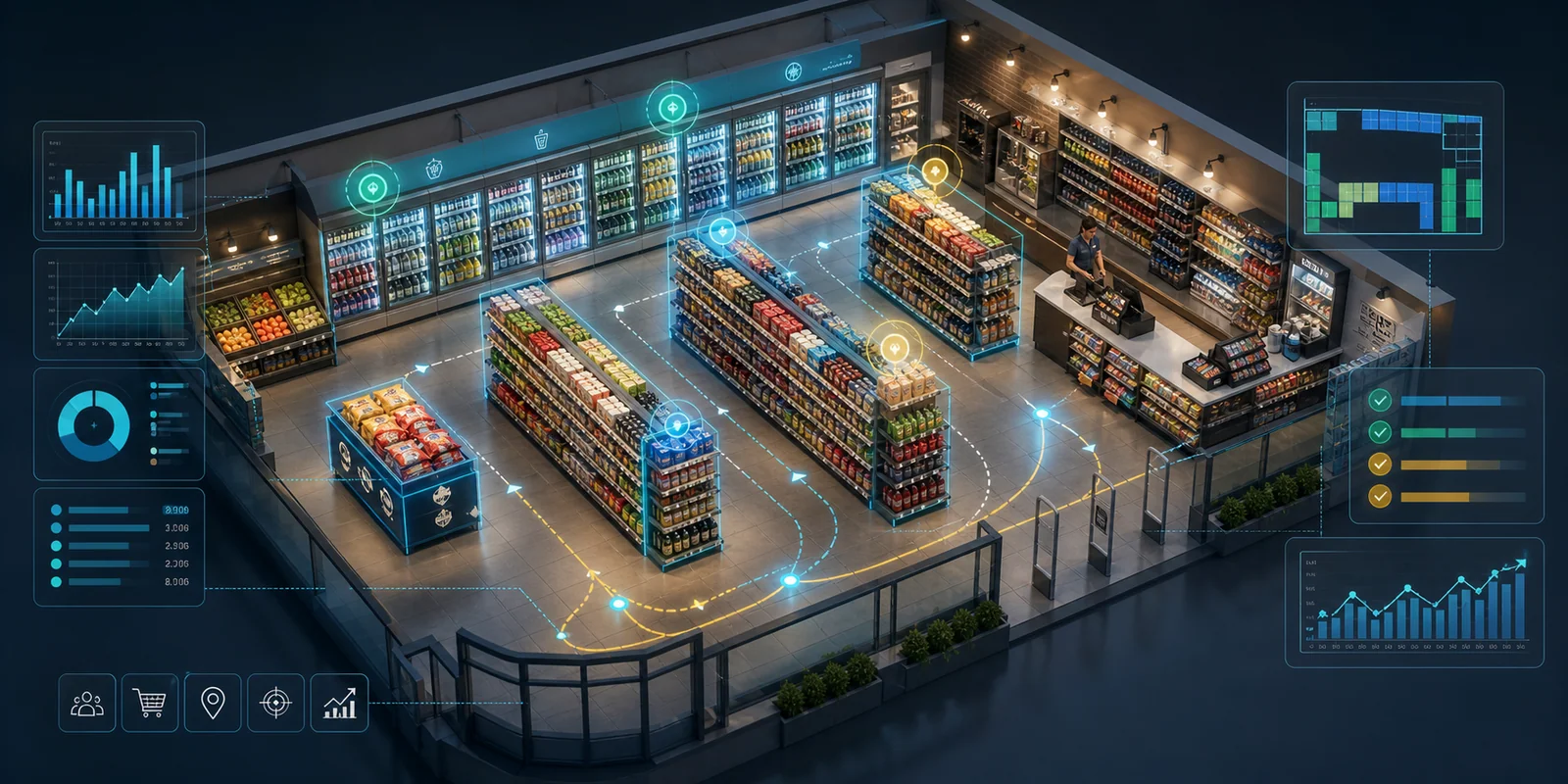
In most FMCG companies, Perfect Store begins as a good idea and ends as a checklist.
The sales rep enters the outlet, ticks a few boxes, photographs the shelf, records whether the promotion is there, whether the price label is placed and whether the display exists. The data then travels upward. A few days later, the manager sees a report. In the best case, there are photos. In the worst case, there are only claims.
The problem is that the checklist answers the easiest question:
"Was it done?"
Perfect Store should answer a harder one:
"Does this outlet work in a way that lets the brand win at the moment of purchase?"
That is the real difference. Perfect Store is not only a shelf. It is not only a planogram. It is not only whether the rep visited the store. It is a full execution model: which products should be present, where they should be located, how visible they should be, what promotion should be active, what should happen at the checkout, in the cooler, in the promo bin, on the endcap and in every point where the shopper makes a decision.
Bain describes Perfect Store as a methodology that connects the right stores, the right products and disciplined sales execution. In Bain's work on advanced analytics and Perfect Store, the outcome is clear: with the right process, CPG companies can deliver more than 5% sales growth, often within the first year. In real programs, the effect often sits in the 2-5%+ range depending on category, channel, starting execution level and implementation discipline.
This is not magic. It is commercial math.
Perfect Store is not a store without mistakes
The name can mislead. "Perfect Store" sounds like an ideal outlet where everything is arranged flawlessly.
In reality, Perfect Store is more practical: a defined standard for how an outlet should execute the brand strategy.
That standard is not identical everywhere.
A small convenience store should not have the same Perfect Store model as a supermarket. A HoReCa outlet should not be measured like modern trade. A gas station should not follow the same logic as a hypermarket. Even two stores in the same channel can have different potential, shopper missions and category roles.
So a good Perfect Store program does not begin with "what should we check?"
It begins with:
"What needs to be true in this type of outlet for us to win the purchase?"
The standard follows from that.
For a beverage category, it may mean cold availability in the cooler, hero SKUs at eye level, impulse placement near checkout, a secondary display at the entrance, a visible promo price and enough facings for the top flavors.
For snacks, it may mean the main shelf in the category, a promo bin, an endcap in a high-traffic aisle, a bundle around beverages, checkout placement for impulse SKUs and a must-stock list for the fastest movers.
For personal care, it may mean brand blocking, correct vertical arrangement, visibility for a new product, price compliance and promotion communication.
That is why Perfect Store is not "one checklist." It is an operating map of the store.
Points of sale are bigger than the shelf
When people talk about retail execution, they often think only about the shelf. The shelf matters, but it is not the whole store.
In a real outlet, the shopper's decision can happen in several places:
- main shelf - where the category lives permanently;
- refrigerated equipment - critical for beverages, dairy, ready-to-eat and impulse categories;
- endcap - the end of the gondola, where promotions win visibility;
- promo bin or island - secondary placement with high accessibility;
- checkout zone - small, impulse and high-frequency products;
- entrance and high-traffic aisles - places shoppers see before reaching the category;
- backroom - the invisible zone that decides whether stock reaches the shelf on time.
That is why the visual logic of Perfect Store should look more like a store plan than a shelf close-up. The question is not only "does the product have facings?" The question is:
"Is the product in the right zone for the role it needs to play?"
A hero SKU in a cooler may have a different value than the same SKU on a dry shelf. A promoted product on an endcap may perform differently than the same promoted product hidden inside the main category. A checkout SKU may have impulse value that a standard shelf check never captures.
Perfect Store needs to measure that logic.
The five levers that actually move Perfect Store
Large FMCG companies use different names for similar programs: Perfect Store, Golden Store, RED, Flawless Execution, PICOS and other internal frameworks. The details differ, but the foundation usually rests on a few levers.
1. Availability. The product must be physically available to the shopper. Not "in the system", but "can be taken from the shelf now." This includes on-shelf availability, OOS risk, backroom issues and the right order.
2. Assortment. The right SKUs must be in the right store. Not every outlet needs the full portfolio. But every outlet needs its must-stock range based on potential, channel, shopper mission and category.
3. Placement and visibility. The product must be where the shopper expects to find it, with enough facings and a logical arrangement. This includes planogram compliance, share of shelf, eye-level positioning, brand blocking and visibility versus competitors.
4. Price and promotion. The agreed price is not enough. It must be correctly placed, visible and synchronized with the promotion mechanic. A promotion without availability or without a label is a paid but unexecuted strategy.
5. Activation. POSM, secondary displays, coolers, bins, checkout placement and in-store communication. This is where the marketing plan becomes physical reality.
These levers should not carry equal weight.
In a promotion week, availability and secondary display may matter more. For a new product, penetration and must-stock compliance may be more important. In a mature category, share of shelf and price may carry more impact.
A good Perfect Store framework is weighted, not flat.
Perfect Store Score: why one number is not enough
Many companies build a Perfect Store Score from 0 to 100. That is useful because it gives one common view.
But if the score is poorly designed, it can mislead.
An outlet scoring 82 may look healthy. But if it is missing availability on a hero SKU, that 82 is dangerous. Another store may score 72 but execute the critical SKUs and miss only low-value POSM elements.
So the score needs logic:
- KPIs should be weighted by business impact;
- store potential should influence priority;
- promotion periods should be measured separately;
- must-stock and hero SKUs should carry more weight;
- reasons for gaps should be recorded;
- the result should lead to action, not only reporting.
In other words: Perfect Store Score should not be a nice number. It should be a decision signal.
Why the empty shelf distorts every other data point
One reason Perfect Store matters so much is that poor execution distorts analysis.
If an SKU does not sell, the product may be weak. But it may also be missing from the shelf. It may be in the wrong position. It may be a promotion without a label. It may be a competitor block taking the visibility. It may be a cooler where the product is absent while the system claims stock exists.
If you cannot see physical execution, you may make the wrong commercial decision.
NielsenIQ shows how expensive this becomes in out-of-stock situations: across several Western European markets in 2022, around 4% of FMCG products were out of stock on the shelf for an average of 4 days, causing billions in missed sales. The same analysis shows that when a regular product is missing, shoppers may change stores or buy another brand.
Corsten and Gruen have long shown that out-of-stock is not simply "the sale will happen tomorrow." When the product is missing, shoppers may switch brand, switch store, change size, delay the purchase or give up entirely. That is revenue loss and loyalty loss.
Perfect Store therefore becomes a protection mechanism against wrong conclusions. Before deciding that the product, promotion or rep is weak, first check whether the strategy was actually executed in the store.
Distribution without Perfect Store is only half a win
Route-to-market can put the product into many outlets. That is the first battle.
But presence in a store is not the same as winning inside the store.
NielsenIQ explains the logic of Total Distribution Points and weighted distribution: what matters is not only how many stores carry the product, but how important those stores are and how deep the assortment is. Perfect Store adds the next layer: once the product is in the right store, is it executed correctly?
You can have good numeric distribution but weak Perfect Store:
- the product is present, but not visible;
- the must-stock SKU is missing;
- the promotion is agreed, but not placed;
- the cooler is filled with secondary items;
- the endcap is captured by a competitor;
- checkout placement is not working;
- the outlet is in the route, but does not receive the right action.
That is why Perfect Store is the bridge between strategy and execution. Without it, distribution may look strong in a report but weak at the point of purchase.
Why manual audits are not enough
Manual audits have a role. They carry context. The sales rep sees things the system may not know: customer attitude, local change, competitor push, payment issues, storage limitations, actual staff behavior.
But manual audits should not be the only source of truth.
The reasons are simple.
Subjectivity. Two people can rate the same cooler differently. One counts facings one way, another counts differently. One sees POSM as present, another sees that it is placed incorrectly.
Time. In a real route, the rep does not have 15 minutes to perform a detailed audit for every SKU, zone and secondary display. If the process is too heavy, it gets shortened in the field.
Delay. If the result reaches the manager days later, action is already late. Perfect Store has value only if the gap can be fixed during the same visit or before the next peak.
Lack of proof. A checklist is a claim. A photo, timestamp, GPS and automated recognition make the claim verifiable.
This does not remove the human from the process. It means the human should be freed from mechanical counting and focused on corrective action.
How computer vision changes Perfect Store
Computer vision is powerful not because it "recognizes products", but because it turns the physical store into a measurable data layer.
From one image, the system can extract:
- whether the SKU is present;
- how many facings it has;
- whether there is an empty gap;
- where the product sits versus the planogram;
- share of shelf;
- competitor intrusion;
- whether POSM is placed;
- whether the price is visible;
- whether a secondary display exists;
- whether the cooler zone works as intended.
But that is only the first part.
The real value appears when the result turns into the next action:
- "replenish hero SKU from backroom";
- "restore the brand block";
- "add missing must-stock SKU to the order";
- "check the promo label";
- "move the product to the right zone";
- "escalate to the distributor";
- "prioritize this outlet in the next route."
If computer vision only uploads photos into a report, the value is limited. If it closes the execution loop, Perfect Store becomes a daily management system.
How AI makes the framework smarter
Classic Perfect Store score says what is missing.
AI-native Perfect Store should say what matters most to fix first.
That is the difference between compliance and intelligence.
Not every gap has the same impact. Missing low-value POSM is not the same risk as a missing hero SKU in a promotion week. One fewer facing in a small outlet is not the same as a lost cooler slot in a key store. An incorrect label outside a promotion is not the same as a wrong promo price in a high-traffic category.
AI can prioritize gaps by:
- store potential;
- SKU importance;
- promotion status;
- days until the next visit;
- out-of-stock risk;
- cost of correction;
- likelihood the rep can fix it now;
- expected sales impact.
Then the rep does not receive a list of 20 violations. They receive the 3 actions most likely to change the outcome.
What a good Perfect Store process looks like
The practical process should not be complicated.
1. Define the standard by channel. What does Perfect Store mean for convenience, supermarket, HoReCa, pharmacy, gas station or traditional trade? Which SKUs are must-stock? Which zones matter? What carries the most weight?
2. Weight the KPIs. Availability, placement, share of shelf, price compliance, POSM, secondary display, cooler zone, checkout zone. They are not equally important.
3. Measure objectively. Photo, computer vision, GPS, timestamp, automatically extracted shelf metrics and reason codes.
4. Give action in the moment. The rep needs to know what to do now, not three days later.
5. Connect it to the order. If the shelf scan shows OOS risk, the suggested order should change.
6. Connect it to the route. If a key store repeatedly loses Perfect Store score, route priority should know.
7. Manage patterns. If the same issue repeats across many outlets, it is not one rep's mistake. It is a system signal: weak promotion mechanic, weak distributor, wrong planogram, insufficient stock or wrong incentive.
This turns Perfect Store from inspection into operating rhythm.
What the sales rep should see
The rep does not need theory. They need a short, clear instruction.
For example:
"Cooler: hero SKU is missing. It was included in the last delivery. Check backroom and restore 6 facings."
"Checkout: impulse SKU is absent. Add it to checkout placement; this outlet type has high attach rate."
"Promo bin: display exists, but promo label is missing. Place label before confirmation."
"Main shelf: share of shelf is below the agreed threshold. Restore brand block."
That is action, not reporting.
What the manager should see
The manager needs a different view:
- which outlets lose the most weighted Perfect Store impact;
- which levers fail most often - availability, price, POSM, share of shelf;
- which SKUs are the most common source of gaps;
- where the issue is rep, distributor or supply;
- which promotions are paid for but not executed;
- how fast gaps are closed;
- which corrections actually lead to sales.
If the manager only sees "who filled the checklist", the system becomes a control tool.
If the manager sees impact, the system becomes a growth tool.
The most common mistake: measuring everything equally
A weak Perfect Store process tries to measure everything. A good process measures what moves the result.
If the checklist becomes too long, reps work around it. If the score punishes small issues as heavily as critical ones, managers lose trust. If KPIs are not linked to category, channel and potential, the result becomes administrative.
Perfect Store should be strict, but not bureaucratic.
The right question is:
"Which 5-7 conditions in this outlet have the highest chance of changing the sale?"
Everything else is secondary.
In short
Perfect Store is not a beautiful shelf. It is not a checklist. It is not a photo. It is not a quarterly audit.
It is a system that translates commercial strategy into the physical store:
- the right assortment for the right outlet;
- physical shelf availability, not only system stock;
- visibility in the right zone - shelf, cooler, endcap, promo bin, checkout;
- price and promotion that are actually executed;
- POSM and secondary displays that work at the moment of purchase;
- a score that leads to action;
- computer vision that makes execution measurable;
- AI that prioritizes and closes the loop.
The real question is not:
"Do we have a Perfect Store checklist?"
The real question is:
"Can every important outlet show our strategy physically, measurably and on time?"
That is where growth lives. Not in the presentation, but at the points of sale.
Related in Optimasoft
- Shelf computer vision explains the technical layer behind objective facings, OSA and planogram-gap measurement.
- The image recognition solution turns store photos into shelf signals that can feed a Perfect Store score.
- On-shelf availability goes deeper into the most critical Perfect Store lever: whether the product is actually on the shelf.
- Optimasale is the product layer where these signals connect to visits, tasks, orders and manager visibility.
Sources
- Bain & Company - Perfect Store: How advanced analytics is transforming sales execution
- Bain & Company - Perfecting Sales Execution
- NielsenIQ - Can the FMCG industry afford to lose billions from empty shelves?
- NielsenIQ - Total Distribution Points and CPG brands
- Corsten & Gruen - Retail Out-of-Stocks: A Worldwide Examination of Extent, Causes and Consumer Responses
- ECR Retail Loss - On-shelf availability
- ECR Europe - Optimal Shelf Availability
Related articles