Route-to-Market in FMCG: How Product Reaches the Shelf and Why It Decides Growth
Before you optimize anything with AI, the product has to reach the right stores, in the right quantity, at the right price. What Route-to-Market is, why it is critical, and how AI rewires it.
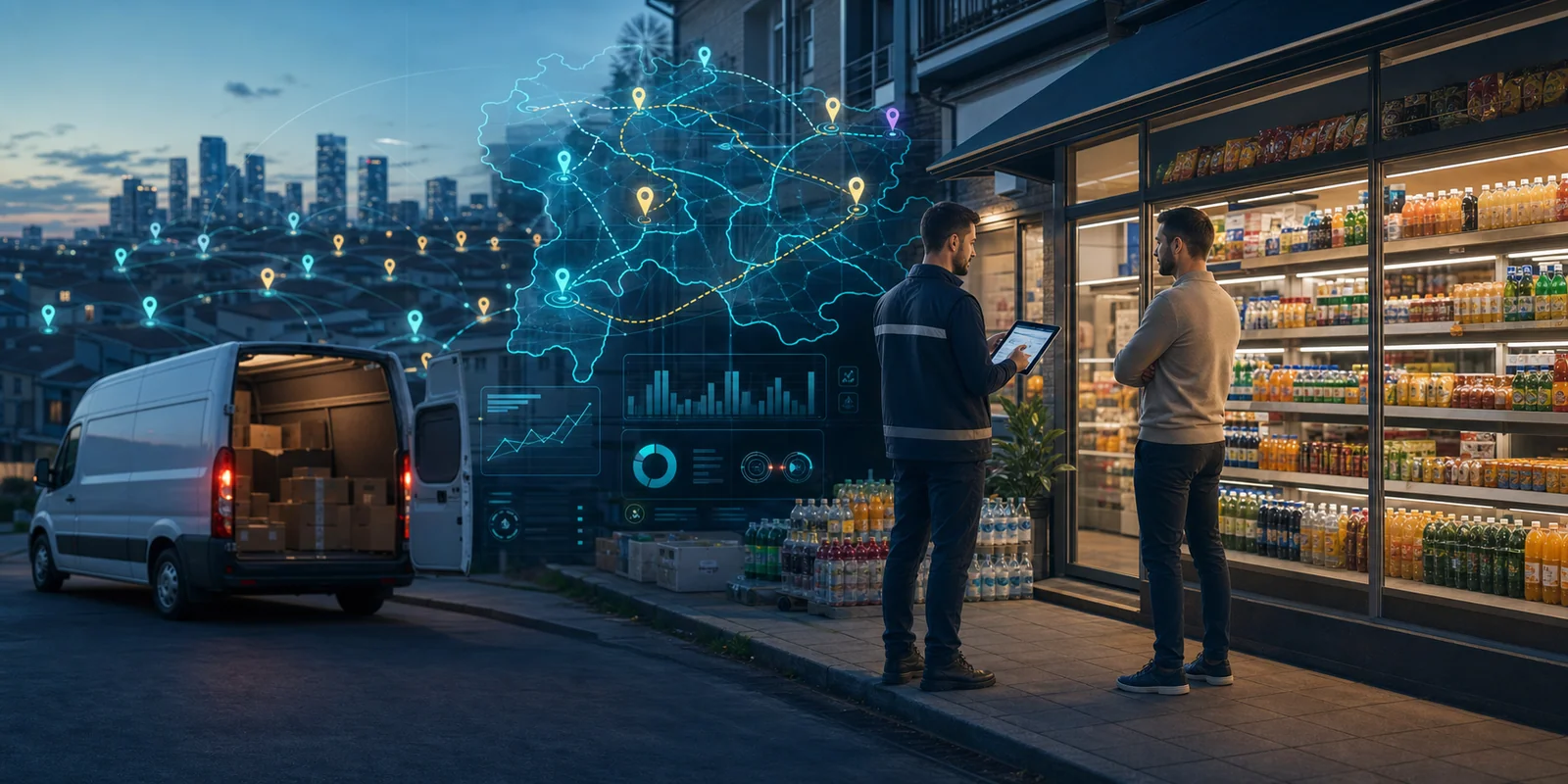
A product can be perfect. The packaging, the price, the advertising, the taste. But if it never reaches the right shelf, in the right store, at the right moment, none of that matters.
In FMCG the battle is rarely won at headquarters. It is won across tens of thousands of outlets, most of which you will never see in person. And the way product reaches those outlets has a name: Route-to-Market.
It is one of the most underrated words in the industry. It sounds logistical and dull. In reality it is one of the largest growth levers a company has.
What Route-to-Market actually is
Route-to-Market (RTM) is the model by which a company sells and delivers its products to the point of sale and services its trade accounts.
Strategy& (PwC) defines it precisely: route-to-market models determine "sales volume, the ability to deliver proper levels of customer service in a cost-effective manner, and success at securing retail shelf space." A good model balances three things at once: customer needs, revenue growth and cost-to-serve.
That is the point. RTM is not "how we drive the truck." RTM is the answer to a set of connected questions:
- Which outlets are we even present in?
- How often do we visit them?
- Who serves them: us directly, a distributor, or a wholesaler?
- What does each visit and delivery cost?
- And does that shelf presence return more than it costs?
It sounds simple. In a market with a few thousand modern stores it really is manageable. In a market with tens or hundreds of thousands of small outlets, RTM becomes the hardest part of the business.
Why RTM decides more than it appears
McKinsey puts the conclusion as strongly as possible for emerging markets: effective distribution is "the single most important determinant of success" in African consumer markets. Not the product. Not the price. Distribution.
Bain arrives at the same place from a different angle: a strong route-to-market strategy can be "a source of long-term competitive advantage" for consumer products companies.
The reason is that most of the world does not shop in hypermarkets. It shops in small neighborhood stores.
The numbers make it clear. According to Bain, traditional trade (small independent stores) has penetration of 98% in India, 94% in Nigeria, 84% in Indonesia and 68% in Turkey. China alone has more than 3 million traditional stores, which account for at least 40% of FMCG sales and are served through more than 10,000 local wholesalers. Bain estimates roughly 100 billion dollars of markup flows through this fragmented chain every year.
This is the reality RTM has to solve: a huge number of small outlets, each with its own potential, cost and behavior. Whoever finds a better way to reach them wins share the competitor cannot even see.
The classic RTM models
There is no single correct RTM. There are models, each with its own balance of control, reach and cost.
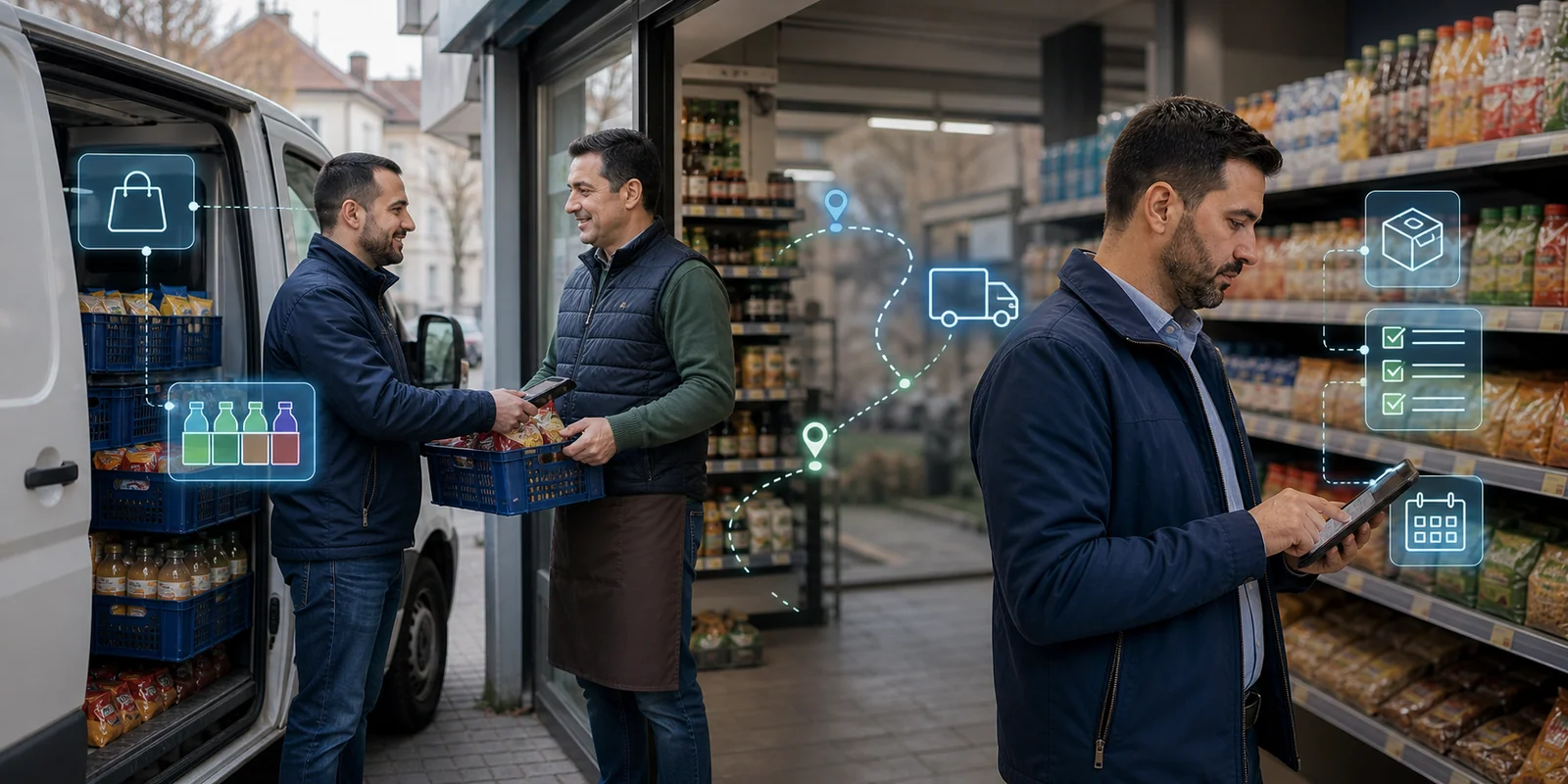
Direct store delivery (DSD, van sales). The manufacturer bypasses the distributor warehouse and replenishes the store directly. Upside: fastest time to shelf, lower chance of stockouts, more merchandising control, real-time visibility. Downside: expensive. You carry all the logistics, people and fleet.
Pre-sell vs van-sell. In pre-sell the order is taken on one visit and delivered later. In van-sell the sale and the delivery happen in a single visit, which works where frequent, fast replenishment is needed.
Distributor model. A local partner takes on warehousing, logistics and service. Upside: reach without your own infrastructure. Downside: you lose direct sight of what is happening at the outlet and depend on the partner's execution.
Hybrid. Direct for modern trade and key accounts, distributors for general trade. Most serious players end up exactly here.
A strong RTM does not pick one model for the whole country. It mixes them by segment. McKinsey describes a vivid example from Ghana: a confectionery maker mapped outlets by volume and built a different model for each segment. Small neighborhood kiosks got deliveries six times a week via the distributor's motorized tricycles. Larger kiosks: van deliveries three times a week, plus a sales-rep visit every two weeks for merchandising.
That is the essence of good RTM: not one rule for all, but the right service for each type of outlet.
How we even measure "good" RTM
This is where many people are surprised how concretely distribution is measured.
Numeric vs weighted distribution. Numeric distribution is the percent of stores that carry the product. Weighted distribution (by ACV, All Commodity Volume) weights stores by their size. NielsenIQ gives a clear example: a product in 2 of 3 stores is 67% numeric distribution, but if those 2 stores make 150 of a 200 million market, weighted distribution is 75%. That is why weighted is the more honest figure: what matters is not how many stores you are in, but how much those stores weigh.
On-shelf availability (OSA) and out-of-stocks (OOS). This is the silent killer. The landmark Corsten and Gruen worldwide study, based on around 72,000 shoppers, found an average out-of-stock rate of 8.3%. Twenty years later that figure has barely moved. And it is expensive: when an item is out of stock, the retailer loses on average around 30% of its sales. According to Corsten and Gruen, the shopper response breaks down as: 31% go to another store, 26% switch brand, 19% take a different size of the same brand, 15% delay the purchase, and 9% simply do not buy. ECR Europe estimates losses in Europe at around 4 billion euros a year, with more than 85% of the causes of stockouts sitting inside the store, not upstream.
The other side is just as clear. McKinsey calculates that a one-percentage-point improvement in in-stock rates lifts sales by 20 to 35 basis points. Availability is not an operational detail. It is a direct revenue lever.
Coverage, frequency, drop size, cost-to-serve. How many outlets we actually serve, how often, the average order per visit, and what it costs us. Cost-to-serve matters especially: on FMCG margins, where a rep's time and travel are a large share of cost, route and frequency move profitability directly. And trade spend alone consumes around 20-30% of revenue. Every point counts.
Where the classic RTM breaks
The problem is not that companies have no RTM. They do. The problem is that it looks good on paper and breaks in reality.
Salesframe puts it precisely: a rep has 60 outlets on the call plan, but realistically can visit 40 in a week. Which 40? That is "left to the rep's discretion rather than the strategy's logic."
And from there everything unravels:
- coverage is 100% on paper, but the real figure is different;
- visits happen by habit and convenience, not by priority;
- in a distributor model the brand loses direct sight of the outlet;
- frequency is the same for everyone, even though outlets are not the same at all;
- the manager sees the problem after the cycle ends, when it is too late.
McKinsey adds the strategic mistake: companies often invest heavily in distributors "with poor outlet coverage, shoddy execution, or suboptimal capabilities," instead of selecting partners to maximize coverage or optimize cost-to-serve.
These are not reporting problems. These are decisions made every day, dependent on data, and almost always made with incomplete information.
This is exactly where AI comes in.
Now AI enters: from geography to potential
The classic RTM orders the day by geography and habit. Short route, convenient sequence, equal frequency.
AI-native RTM asks a different question:
Which visits will change the result this week?
Not all outlets deserve equal attention today. One has a high risk of a top-SKU stockout. Another is in a promo week. A third is strategic for the category. A fourth has low potential and can be served less often. A fifth has a payment problem.
Bain describes this approach as finding the "crossover point" between direct service and channel: each customer is plotted against its real potential and cost, not against the district it falls into. The results of their Perfect Store work are measurable: sales growth of more than 5%, typically in the first year, alongside a reduction in cost of sales contact of 10 to 25%.
The same logic, only driven by data in real time rather than by an annual analysis.
What AI actually changes
AI is not "one more window" on RTM. The change is in three concrete decisions made every day.
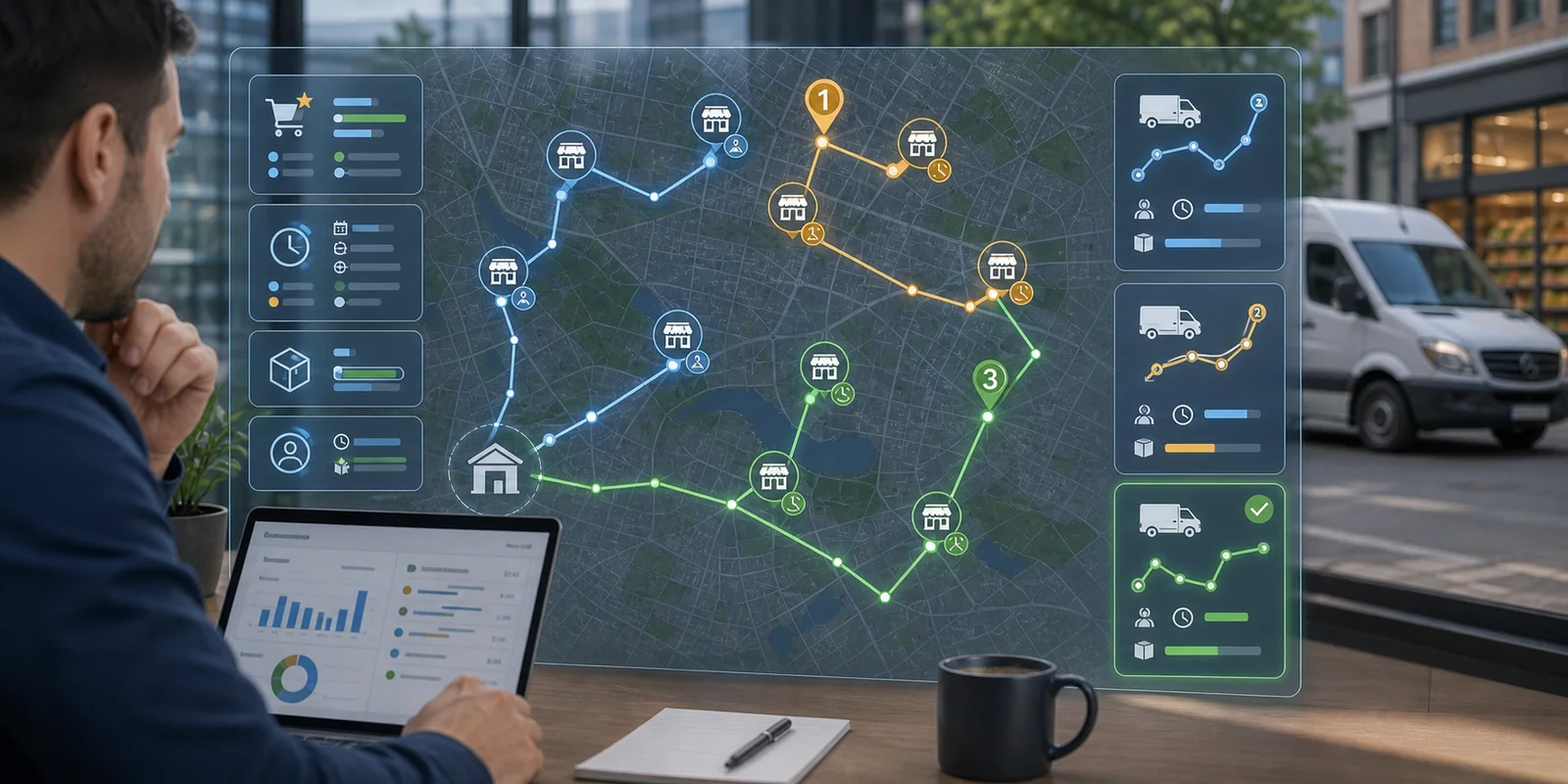
1. Coverage and frequency by value. Instead of equal frequency for all, the model scores each outlet by potential, risk and contribution and suggests who to visit, how often and in what priority. The kiosk with high sell-out and an active promotion moves up. The low-potential outlet moves down, without dropping out of coverage.
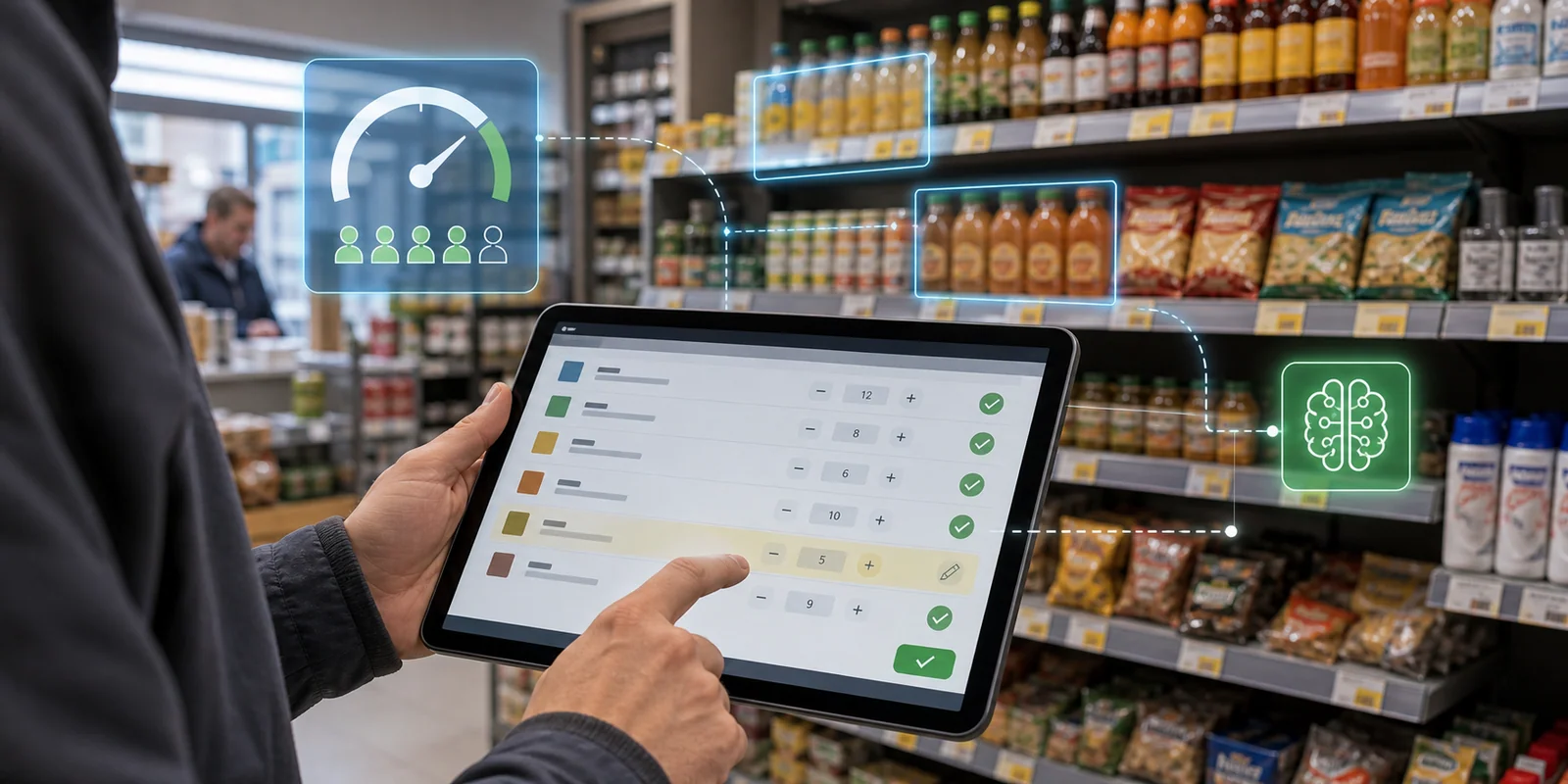
2. Suggested order instead of "the usual." In the classic model the order is a habit: the rep looks at the past and adds roughly the same. But "the usual" is dangerous with seasonality, promotions and stockouts. The AI order reads more signals (sell-out, frequency, availability, promo calendar, behavior of similar outlets) and suggests a quantity with a reason: "12, because sell-out is rising, the promotion starts Friday, and stock covers only 4 days." McKinsey reports that AI forecasting reduces forecast error by 20 to 50%. In one of their personal-care cases, accuracy improved by 13%, shortages dropped by 40%, and inventory fell by 35%.
3. Cost-to-serve segmentation. Not every customer should be served the same way. AI helps split the network by value and cost and apply a different service model, so the expensive visits go where they produce a result.
This is the difference between AI as a demonstration and AI as part of the daily process. The value does not come from the model itself, but from the recommendation reaching the rep while they are still in the store.
Autonomous, but controlled
The word "autonomous" sounds risky in a business context. And it should. So the right model is not "AI does whatever it wants," but controlled autonomy:
- AI can recommend freely;
- it can execute only permitted actions;
- sensitive decisions pass through a human;
- every decision has an explanation and an audit trail;
- permissions follow the role, the region and the customer.
This is not excess caution. Gartner predicts that by 2030 half of supply-chain management solutions will include agentic AI, but at the same time warns that more than 40% of agentic AI projects will be cancelled by the end of 2027 due to unclear value, cost and weak risk controls. The difference between the two groups is discipline, not technology.
In Europe this also has a regulatory dimension. The AI Act has been in force since 1 August 2024, with general application arriving on 2 August 2026. Most RTM and route tools will not be high-risk in themselves, but transparency, decision logging, data control and human oversight are becoming a standard of trust. That is why "EU-built" is not a decorative phrase: it means the data stays in the right jurisdiction and the recommendations are explainable.
How to start without getting lost
Do not start with an "AI strategy." Start with three questions about RTM itself:
- Which outlets are we present in on paper, but not in reality?
- Which visits happen by habit rather than by priority?
- Where would a recommendation change an action on the same day?
Then pick one focus, not five. For example:
- prioritizing the route by risk and potential for key outlets;
- a suggested order for the top 50 products;
- value-driven coverage instead of geography-driven.
And measure it simply: how many more outlets you cover, how many stockouts you prevent, how much more accurate the order becomes, how much the cost of contact drops. Then scale.
In short
Route-to-Market is the way product reaches the shelf and the rep. It sounds logistical, but it is a commercial lever:
- most of the world's sales pass through many small, fragmented outlets;
- good RTM is not one model for all, but the right service for each segment;
- it is measured concretely: weighted distribution, on-shelf availability, coverage, frequency, cost-to-serve;
- classic RTM breaks where visits happen by habit rather than by priority;
- AI does not replace RTM, it rewires it: from geography to potential, from "the usual" to a recommendation with a reason;
- autonomy has value only when it is controlled and explainable.
The classic question of distribution was "did we reach the store?".
The more important question today is different:
Did we reach the right store, at the right moment, with the right action, before the competitor?
That is where growth is decided.
Related in Optimasoft
- Route optimization turns RTM logic into daily visit priority, not only a map.
- OptimaDMS is the product layer for distributor networks, warehouses, deliveries and coverage.
- AI order taking shows how RTM reaches the next decision: what quantity to order in the specific outlet.
- Optimasale connects route, visit, order and execution tasks into one field process.
Sources
- Strategy& (PwC) - Getting routes to market right
- McKinsey - Winning in Africa's consumer market
- Bain - How advanced analytics is transforming sales execution
- Bain - Taking the mystery out of developing market brand growth
- Bain - China's deteriorating retail distribution system
- NielsenIQ - Total Distribution Points & CPG brands
- Corsten & Gruen - Retail Out-of-Stocks (NACDS guide)
- ECR Europe / Roland Berger - Optimal Shelf Availability
- McKinsey - The State of AI: Global Survey 2025
- Gartner - Half of supply chain solutions will include agentic AI by 2030
- European Commission - AI Act regulatory framework
Related articles