FMCG sales representative 2.0: from data collection to real execution
The next major shift in FMCG field teams is not more forms, more reports or another dashboard. It is helping the sales representative get the right action for the specific outlet while they are still in front of the shelf.
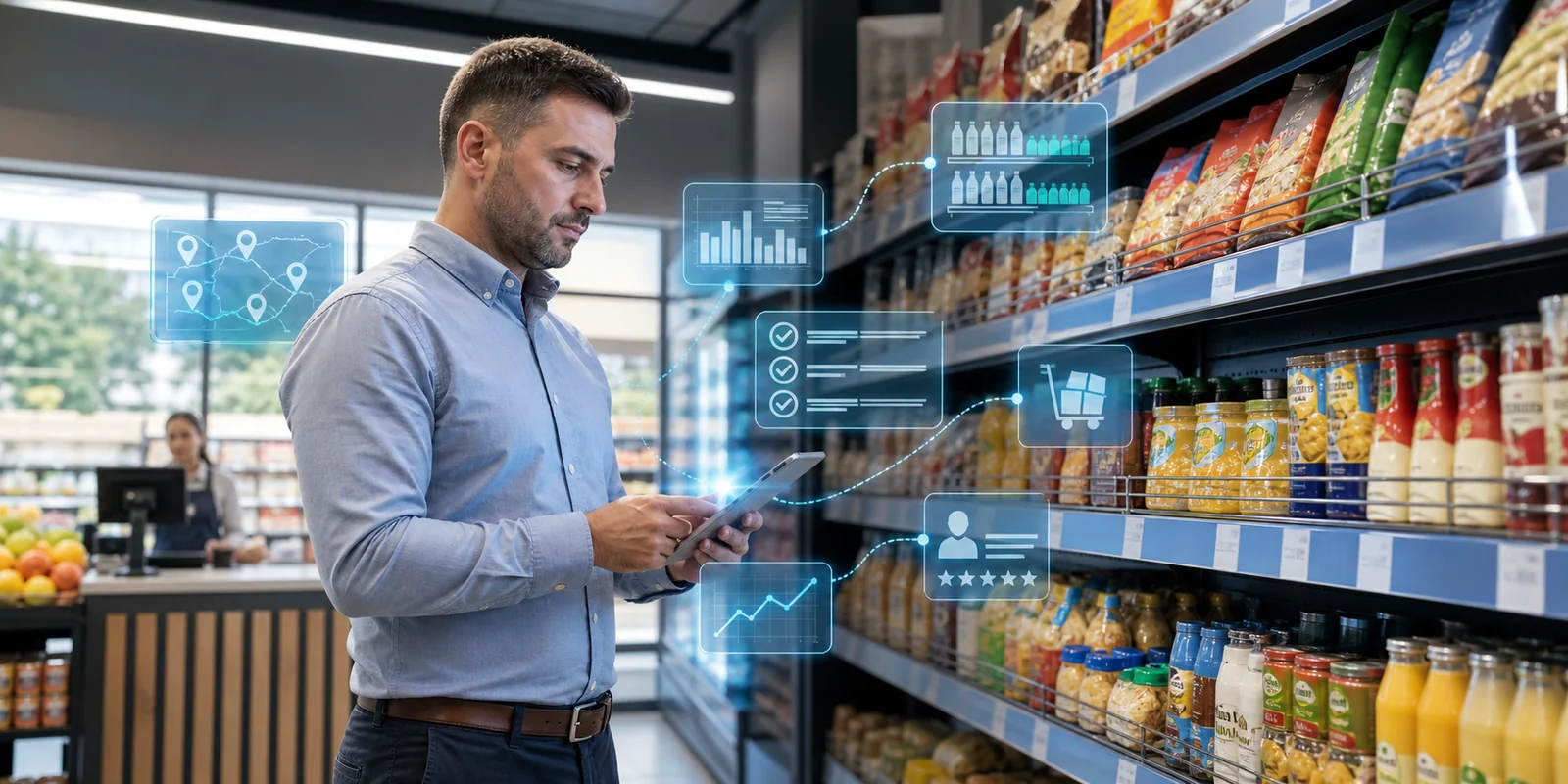
The FMCG sales representative has always been the person who keeps commercial strategy close to reality.
In a presentation, everything looks structured: must-stock list, promotion mechanics, planogram, target, route, trade terms, bonuses and distribution. Inside the store, that strategy meets a moved cooler, an empty shelf, a rushed customer, a competitor with better placement, a promotion that was not installed and an order that is taken by habit.
That is where a large part of the sale is decided.
So the topic of the "sales representative 2.0" is not about replacing people with AI. That is the wrong conversation. The real conversation is different:
How do we remove noisy, manual and delayed work from the sales representative so they can make better decisions inside the outlet?
Classic SFA helped a lot. It digitized visits, orders, tasks, GPS, photos, forms and reporting. But many systems still behave like archives: they record what happened.
The next step is different.
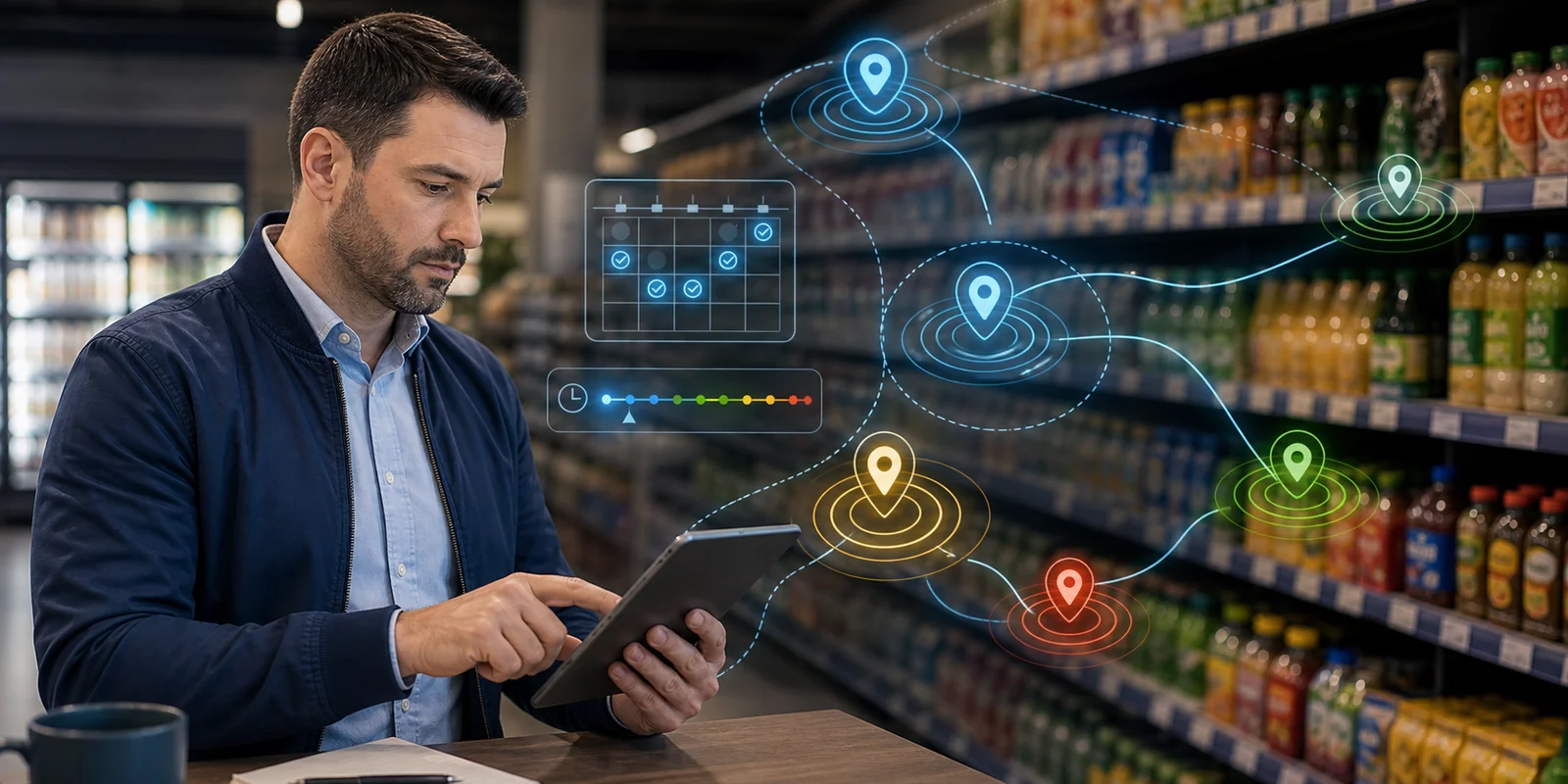
The sales representative 2.0 does not just collect data. They work with execution intelligence: a system that understands the outlet context, prioritizes risk, reads the shelf, recommends an order, suggests the next action, orchestrates follow-up and helps the manager see where execution actually breaks.
The old model: more control, not always more execution
In many FMCG organizations, the sales representative's day looks roughly like this:
- the route is fixed or semi-fixed;
- visit preparation depends on memory, Excel or the previous order;
- tasks are too similar across too many outlets;
- photos are uploaded but often analyzed too late;
- the order is taken based on habit and relationship;
- the manager sees the problem after a day, a week or a month;
- coaching comes after the result, not before the next action.
This is not a failure of the sales representative. It is a limitation of the process.
If one person has 15-25 outlets for the day, several categories, promotions, new SKUs, shortages, receivables, agreements and local exceptions, we cannot honestly expect them to always choose the highest-value action without help.
The problem is not that sales teams do not work. The problem is that they often work with too much information and too little priority.
The new model: the representative as an execution operator
The FMCG sales representative 2.0 is not a "more digital administrator".
They are an operator of execution inside the outlet.
That means the work shifts from:
- entering data to validating a business signal;
- manual judgment to a recommendation with a reason;
- generic checklists to priority based on potential and risk;
- photos as proof to photos as shelf insight;
- standard orders to recommended quantities;
- post-visit reporting to action during the same visit.
This shift is possible because several AI layers can now work together: computer vision, forecasting, route optimization, generative AI, AI agents, workflow orchestration and role-based analytics.
But the key is not to think about them as separate demo modules. In a real business, they need to connect around one simple question:
What should the representative do in this specific store right now?
What an AI-assisted visit looks like
Take a regular outlet in an independent or neighborhood retail network.
Before the visit
The system already knows the customer history: orders, frequency, payments, promotion participation, shortages, previous photos, potential, category, seasonality and behavior against recommended quantities.
Instead of entering the outlet blind, the representative sees a short visit brief:
- why this outlet matters today;
- which SKUs are at risk;
- what was not completed last time;
- whether a promotion needs to be verified;
- whether an asset, cooler, display or POS material needs control;
- what the likely next best action is.
This is the role of Optimasale as the field execution layer: a visit is not just a point on the route, but context for action.
At the shelf
The representative captures a shelf image. Image recognition turns the image into a shelf signal: availability, facings, share of shelf, planogram gap, missing must-stock product, wrong price or promotion issue.
The difference is large.
In the old model, the photo is proof. In the new model, the photo is input to a decision.
If a hero SKU is missing, the system should not merely mark it. It should say:
- this is a critical shortage for this outlet;
- the shortage has repeated for the third time;
- there is stock in the warehouse or distributor network;
- the next order should include a specific quantity;
- if the customer refuses, the reason should be captured as a commercial signal, not just free text.
Here, shelf computer vision and on-shelf availability are not separate topics. They are part of the representative's daily decision.
At order taking
The biggest mistake is to think that the future is "automatic order without a human".
In real FMCG field work, the stronger model is often a recommended order with human control.
AI Order Brain should work as a commercial argument, not a black box. It should not simply say "order 12". It should explain:
- why the quantity differs from last week;
- how the shelf signal influenced the recommendation;
- whether a promotion or seasonal peak is active;
- whether the customer is at risk of overstock;
- what happens if the representative changes the recommendation.
That keeps the representative in control, but stops them from starting from zero. This matters. AI should not devalue the relationship with the customer. It should give the representative a better argument in the conversation.
Around assets, coolers and POS materials
FMCG execution is not only the main shelf.
In many categories, the sale depends on assets: coolers, branded displays, secondary placements, promo bins, checkout zones, POSM, shelf strips, wobblers and price labels.
This is where Asset Validator becomes important. If the company invests in coolers, displays or POS materials, control cannot stop at "there is a photo". The business needs answers:
- is the asset in the right place;
- is it switched on and visible;
- are our products inside it;
- are competitor products placed in our asset;
- is the POS material in the right zone;
- is the problem isolated or systemic for the region.
For the representative, this means less argument and more fact. For the manager, it means visibility investment can be managed instead of assumed.
After the visit
The most expensive part of a field process is often invisible: follow-up.
Someone needs to escalate a shortage. Someone needs to create a supervisor task. Someone needs to notify the distributor. Someone needs to check whether the promo display was installed two days later. Someone needs to send a summary. Someone needs to close the loop.
This is where AI agents and workflow orchestration are critical, but only if governed properly.
An AI agent should not freely "do whatever it decides". It should work within a frame:
- who has the right to approve a follow-up;
- when a task is created automatically;
- when human confirmation is required;
- what is logged;
- what is sent to CRM, DMS or ERP;
- when the workflow is considered closed.
This keeps AI from becoming chaos. It becomes controlled execution.
The five big changes in the representative's role
1. From "following the route" to "managing priority"
The route should no longer be only a geographic optimization problem.
Route optimization in FMCG should account for potential, risk, frequency, promotion calendar, OSA issues, overdue tasks, customer value and the probability of missed sales.
The nearest store is not always the most important store. The largest customer is not always the most urgent one. An outlet with a repeated hero-SKU shortage can matter more than an outlet that is simply convenient on the route.
The sales representative 2.0 does not execute the route mechanically. They understand why the day is prioritized that way.
2. From "filling a checklist" to "closing an action"
A checklist is useful only if it leads to change.
If the task is "check the promotion" but the system does not understand the result, that is reporting. If the task is "check the promotion, capture the display, the model detected a missing price, follow-up was created and the manager can see whether the issue was closed", that is an execution loop.
The difference is closure.
FMCG is full of small misses that look minor in isolation but create a large leak at scale: one missing price, one empty facing, one missing POS material, one habitual order.
The sales representative 2.0 does not just record the miss. They close it or escalate it correctly.
3. From "I know the customer" to "I know the customer plus the data"
The relationship still matters. In independent retail, it is often decisive.
But a good relationship without data can become a comfortable routine. The representative knows the customer, the customer knows the representative, the order repeats and the shelf loses opportunity.
AI does not replace that knowledge. It adds to it.
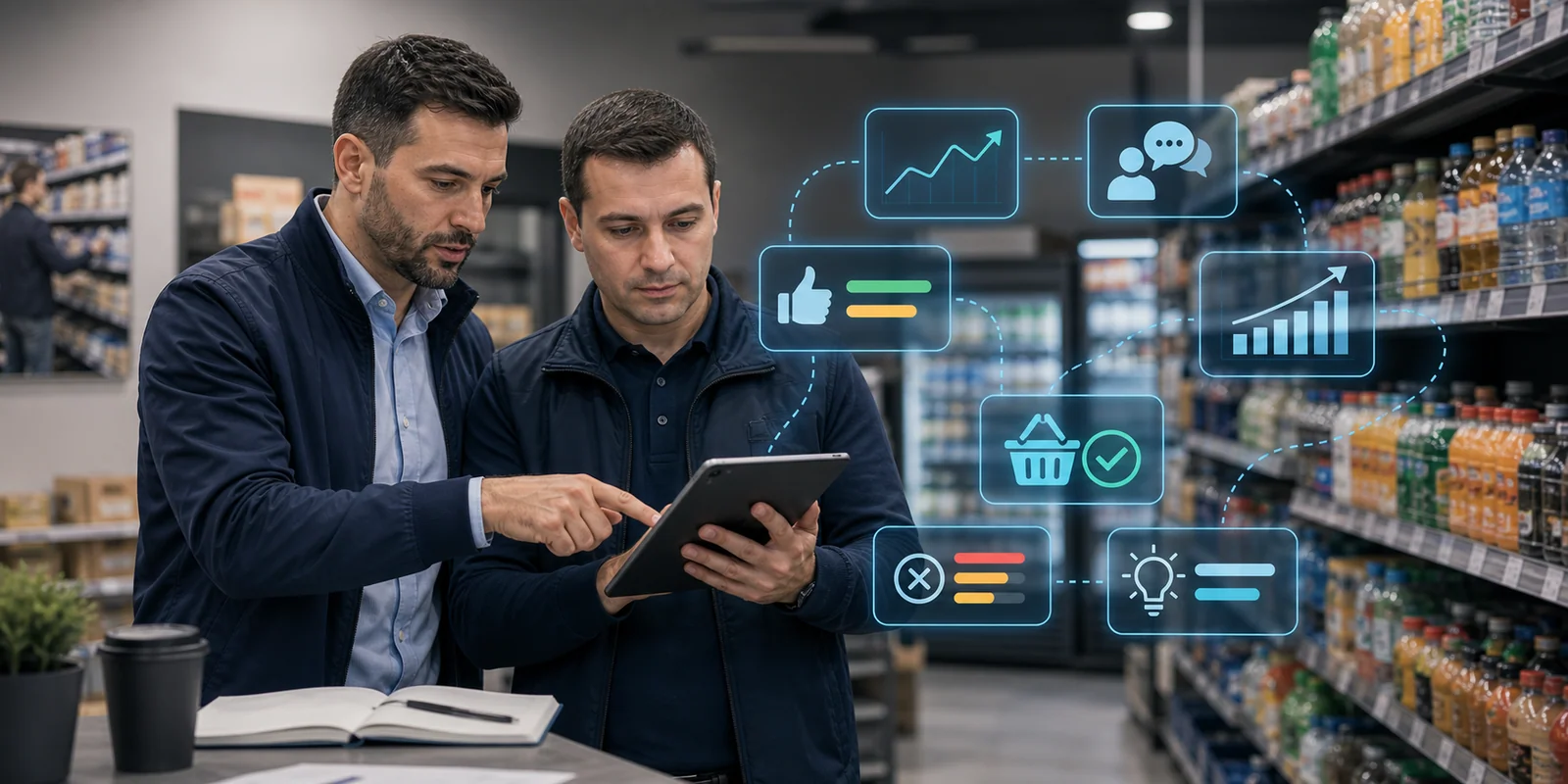
When the representative says "I recommend four more cases because this SKU runs out before the next visit, the promotion starts tomorrow and similar outlets are seeing stronger sell-out", the conversation changes. That is not pressure. It is a reasoned recommendation.
4. From "my manager checks me" to "the system coaches me"
Classic coaching often comes late. The manager reviews KPI, compares results, holds a meeting and gives feedback.
Sales coaching can become much more specific when it is based on real behavior:
- which recommended orders the representative often reduces;
- in which categories they miss OSA problems;
- what objections they record most often;
- whether they close follow-up tasks;
- whether they improve Perfect Store score across their outlets;
- where they need a specific script, not generic training.
This should not feel like surveillance for punishment. It should feel like support for a better customer conversation and stronger result.
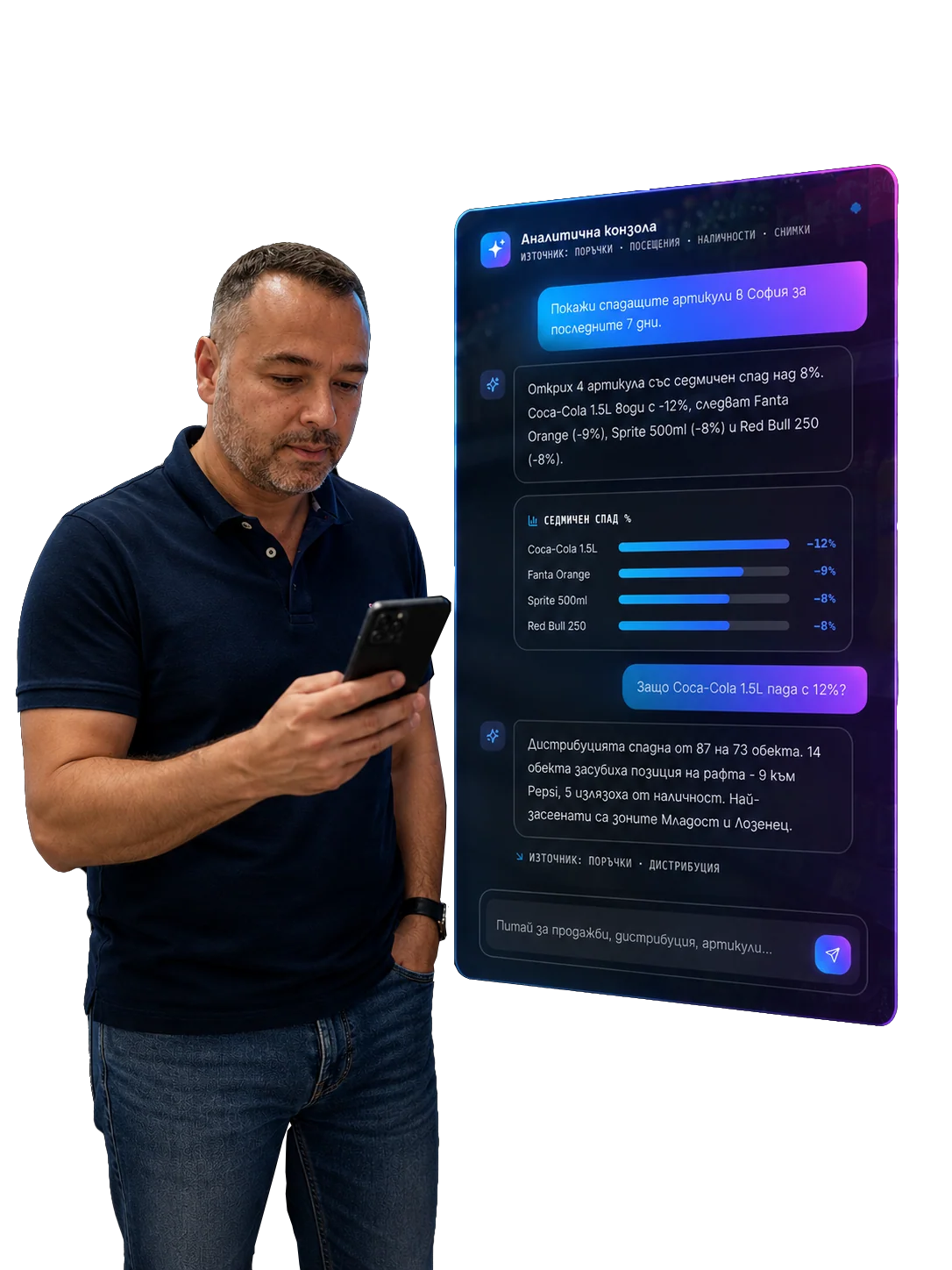
5. From "writing a report" to "talking to the data"
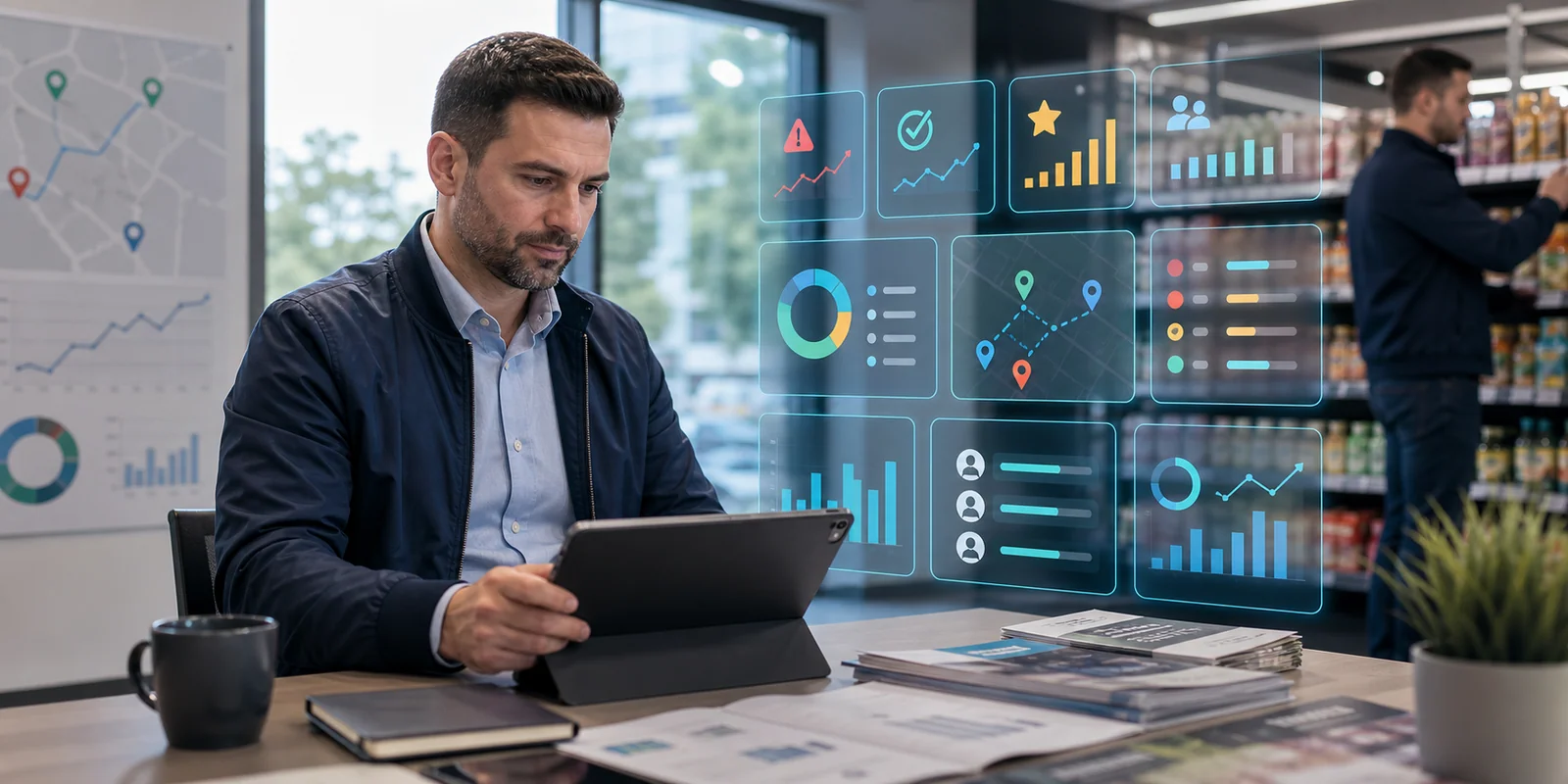
Managers also have a problem: dashboards often show the result, but do not clearly enough show where to act.
Chat BI can change this if it is connected to the real execution layer. The questions should not be abstract:
- "Which outlets lost OSA score this week?"
- "Where are recommended orders rejected most often?"
- "Which representatives have the most unresolved asset issues?"
- "Which routes cover low-potential outlets at the expense of high-risk stores?"
- "Which promotion was physically executed, not merely planned?"
Then BI is not the final stop. It becomes a command layer for the next action.
What not to do
There are several traps that can turn an AI project into noise.
Adding AI on top of a broken process
If outlet master data is weak, product codes are chaotic, planograms are outdated and the promotion calendar is not synchronized, AI will produce confident but poor recommendations.
The first job is not the model. The first job is the operating foundation.
Turning the representative into a data entry operator with more screens
The AI suite should reduce cognitive load, not increase it.
If the representative needs to open five separate screens, read complex explanations and enter more data, adoption will suffer. A good AI experience is short: reason, recommendation, action, control.
Automating without trust
Automation without explanation creates resistance. The representative needs to see why the system proposes something. The manager needs to see why a task was created. The company needs an audit trail.
Especially in Europe, as stricter AI regulation takes effect, governance is no longer a topic for the end of the project. It is part of the design.
Measuring activity instead of impact
Visits, photos and tasks are activity metrics. They are necessary, but not sufficient.
Better KPIs include:
- recovery of OSA problems;
- improvement in Perfect Store score;
- recommended order acceptance rate;
- impact from corrected orders;
- closure rate of execution issues;
- reduced admin time;
- route coverage according to potential;
- improvement after coaching;
- quality of follow-up.
If AI does not change these metrics, it is decoration.
How to implement it pragmatically
An FMCG company does not need to start with "full autonomy". That is usually a poor idea.
A more sensible approach is staged.
Stage 1: stable field execution layer
First, visits, customers, routes, product data, tasks and orders must be clean. Without that, there is no stable AI loop.
Here Optimasale, OptimaCRM and OptimaDMS are the foundation: who the customer is, who visits them, what is ordered, how execution works through distribution and where the process is closed.
Stage 2: one strong AI loop
Do not start with everything at once.
Choose one loop with clear business effect:
- shelf recognition for OSA and Perfect Store;
- recommended order for a specific category;
- route priority for high-value outlets;
- asset validation for coolers and displays;
- coaching for a specific behavior.
One loop working well is better than six that look impressive in a demo but do not change the field.
Stage 3: connect the loops
The real value comes when signals start influencing each other.
The shelf changes the order. The order changes route priority. A repeated OSA problem creates a coaching topic. An asset issue creates a workflow. The manager asks Chat BI where the problem is systemic.
That is when the AI suite stops being a feature list and becomes an operating system for retail execution.
Stage 4: governed autonomy
Once the loops are stable, some actions can be delegated to agents:
- creating a follow-up task;
- preparing a visit summary;
- notifying a supervisor;
- checking for a repeated problem;
- syncing to CRM/DMS/ERP;
- preparing a manager brief.
But decision rights must be clear. What happens automatically? What waits for approval? What is only a recommendation? Who is responsible?
Without these rules, agentic AI becomes risk. With these rules, it becomes scale.
What a strong representative looks like after this
The strong FMCG sales representative will not be the person who enters the most data.
They will be the person who:
- understands the priority of every outlet;
- uses data without hiding behind it;
- enters the store with a clear plan;
- sees the shelf problem in time;
- leads the conversation with evidence;
- accepts or adjusts an AI recommendation intelligently;
- closes follow-up;
- learns from coaching signals;
- sends quality context back to the system.
That is a stronger role, not a weaker one.
AI will take over part of the observation, calculation, summarization and administrative follow-up. But the representative remains the person who understands the customer, the context, the relationship and the real deal.
That is the healthy model: AI for speed, memory and priority; human judgment for trust, context and the commercial conversation.
In short
The FMCG sales representative 2.0 is not a "salesperson with a chatbot".
It is a representative supported by execution intelligence:
- the route is prioritized by potential and risk;
- the visit starts with context, not guesswork;
- the shelf is read from an image;
- the shortage becomes an action;
- the order is recommended with a reason;
- assets are validated objectively;
- coaching comes from real behavior;
- follow-up is orchestrated;
- the manager sees where the process breaks;
- AI agents act within rules, not randomly.
The next competitive difference in FMCG will not be who has more data. Almost everyone already has data.
The difference will be who can turn store data into the right action while the representative is still inside the store.
Related in Optimasoft
- Optimasale is the field execution foundation for visits, tasks, orders and sales team control.
- Image recognition turns shelf photos into shelf signals for OSA, facings, share of shelf and planogram gaps.
- AI Order Brain adds a recommended order with reasoning and human control.
- Route optimization, Sales coaching, Asset Validator, AI agents and workflow orchestration are the layers that turn a visit into a closed execution loop.
- AI-native FMCG explains the broader architecture behind this model.
Sources
- McKinsey - The State of AI: Global Survey 2025
- Bain & Company - Perfecting Sales Execution
- Bain & Company - Sales execution for consumer goods
- NielsenIQ - Can the FMCG industry afford to lose billions from empty shelves?
- ECR Europe - Optimal Shelf Availability
- Gartner - Outcome-focused workflow and agentic execution, 2026
- Gartner - Managing AI agent sprawl, 2026
- European Commission - AI Act regulatory framework
Related articles