Price compliance in FMCG: the wrong shelf price as hidden loss
The wrong shelf price is not a small operational issue. It can kill a promotion, reduce customer trust and hide the real reason behind weak sell-out.

Shelf price looks like a small detail.
But in FMCG, small details often move large results.
If the promo price is not placed, the shopper does not see the offer. If the shelf label is wrong, the shopper may not buy. If the system price and shelf price do not match, the team may analyze the wrong problem.
That is why price compliance is not just a label check.
It is part of retail execution.
Why the wrong price is hidden loss
The wrong price can lead to:
- weak sell-out despite good promotion;
- dispute with the customer;
- confusion for the representative;
- wrong analysis of promo performance;
- lost trust;
- missed sale;
- wrong recommended order.
If the team looks only at sales, it may conclude that the promotion does not work. In reality, the promotion may simply not have been visible as a price.
What should be measured
Price compliance should check:
- is there a shelf price;
- is it correct;
- is it visible;
- does it match the promotion;
- is there mismatch with agreed price;
- is there store-level exception;
- is there photo/evidence;
- is there issue when mismatch appears.
This is especially important in promo compliance, because promotion depends heavily on visible price.
Everyday price and promo price
Price compliance has two different modes.
The first is everyday price. The goal is for the shelf price to match the agreed, system or recommended price according to channel and customer.
The second is promo price. The window is short, the risk is higher and the error directly affects campaign ROI.
These modes should be managed differently:
| Price type | What is critical |
|---|---|
| Everyday price | stability, trust, margin, customer agreement |
| Promo price | timing, visibility, uplift, fast issue closure |
| Markdown/clearance | right period, right SKU, avoiding confusion |
| Store exception | clear approval and audit trail |
If the system treats all price checks the same, it will create noise. Promo mismatch on day one of a national campaign is more urgent than a small everyday deviation in a low-priority outlet.
Source of truth
Price compliance needs a price source of truth.
Otherwise the field team checks the label, but it is not clear what it should compare against.
The practical answer is to know:
- which price list is active;
- which customers have exceptions;
- which promo price applies for the period;
- what the channel-specific rules are;
- who approved the change;
- when the price was synchronized to the mobile app;
- whether DMS/ERP and SFA see the same value.
OptimaSale, OptimaDMS and ERP integration should operate on one logic. Otherwise the representative may receive a task for a "wrong" price that is actually a legitimate store-level exception.
OCR and image recognition
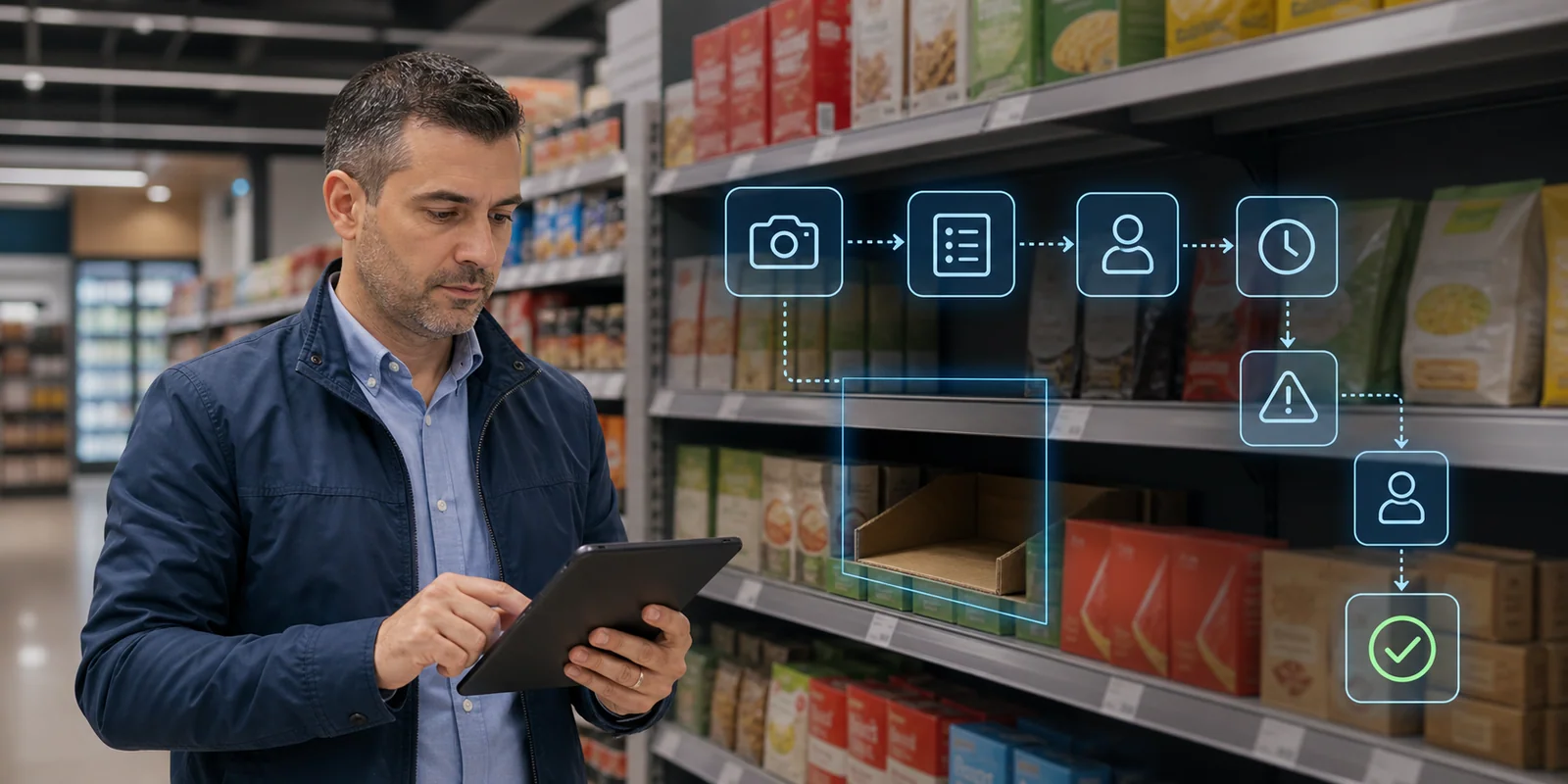
Image recognition can combine shelf detection and OCR:
- finds the price label;
- reads value when possible;
- connects price to product;
- compares with system price;
- detects mismatch;
- creates issue when there is deviation.
OCR is not always perfect. That is why confidence and human review matter.
If the model is uncertain, it is better to mark for review than to give false confidence.
Prioritizing price mismatch
Not every mismatch has the same weight.
A good system should consider:
- size of deviation;
- promotion period;
- store priority;
- SKU priority;
- expected sales impact;
- recurrence;
- whether there is a customer complaint;
- whether there is margin or trust risk.
Then the supervisor does not receive 200 identical alerts, but a prioritized action list.
For example, a wrong promo price for a hero SKU in a high-traffic store should be closed the same day. A small difference for a slow-moving SKU can wait for the next visit or key account review.
That is the value of Workflow orchestration: the signal becomes the right action, not just a notification.
Price compliance as action
Detecting wrong price is not enough.
There should be action:
- representative corrects it if possible;
- supervisor intervenes;
- key account checks agreement;
- store system issue is escalated;
- promo issue closes with evidence.
Workflow orchestration matters because price mismatch often has a short window. If the promotion lasts 7 days, action after 5 days is almost late.
In short
Price compliance in FMCG should measure whether the price the shopper sees is the correct price.
Critical elements are:
- shelf label;
- promo price;
- visibility;
- system vs shelf mismatch;
- OCR confidence;
- issue owner;
- closure evidence;
- impact on promo and order.
Wrong price is not a small defect.
It can be the reason a good promotion looks weak.
Related in Optimasoft
- Image recognition can combine shelf scan and OCR for price compliance.
- Promo compliance shows why price is critical for the commercial campaign.
- Workflow orchestration closes price mismatch as issue with owner and deadline.
- AI Order Brain should account for price/promo context in the recommended order.
- Retail Execution KPI places price compliance in the KPI framework.
Sources
Related articles