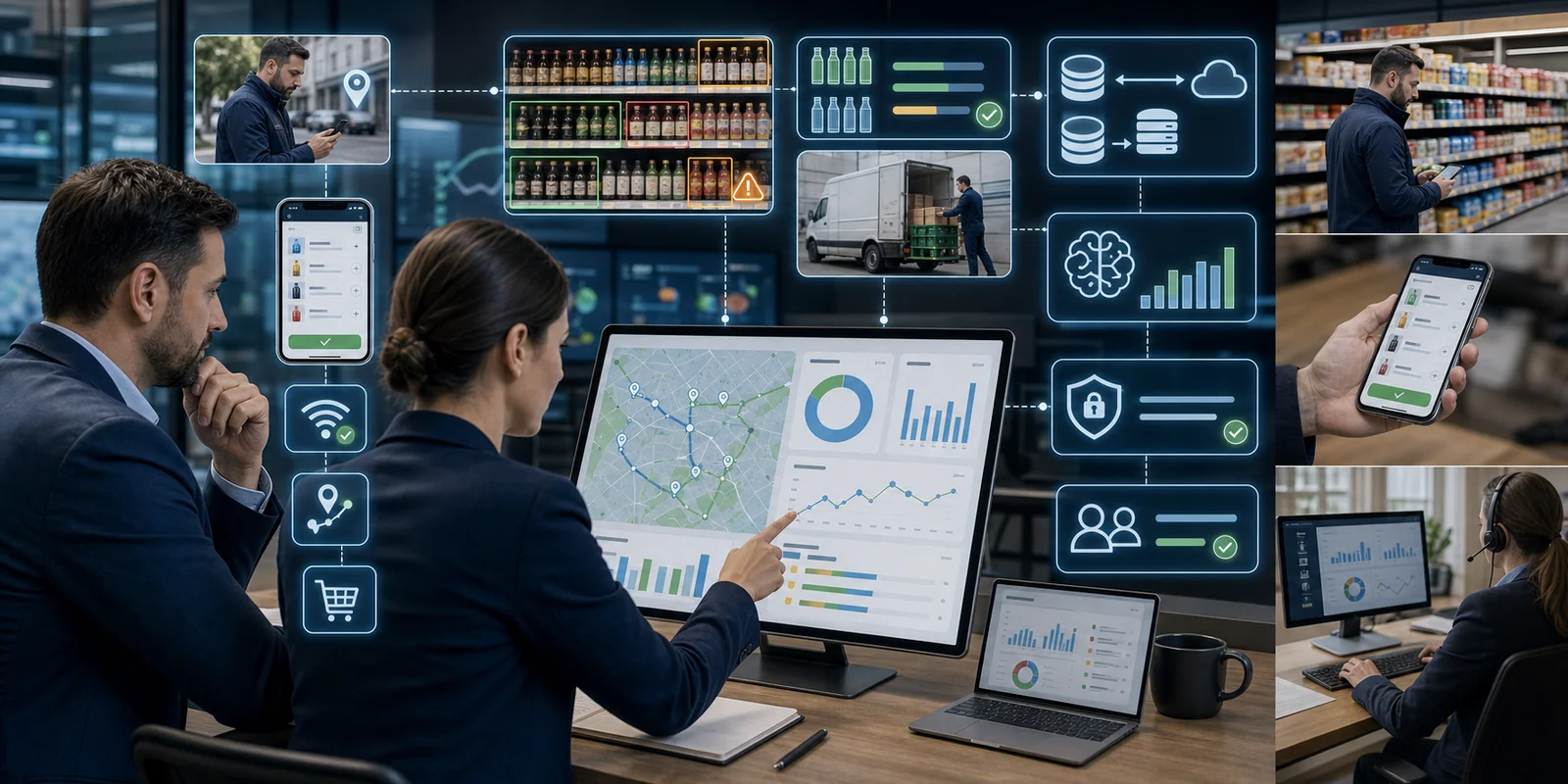
From data to action in FMCG: why the dashboard is not enough
A dashboard shows the problem. An execution loop closes it. Real value appears when data creates an owner, action, deadline, proof and learning.
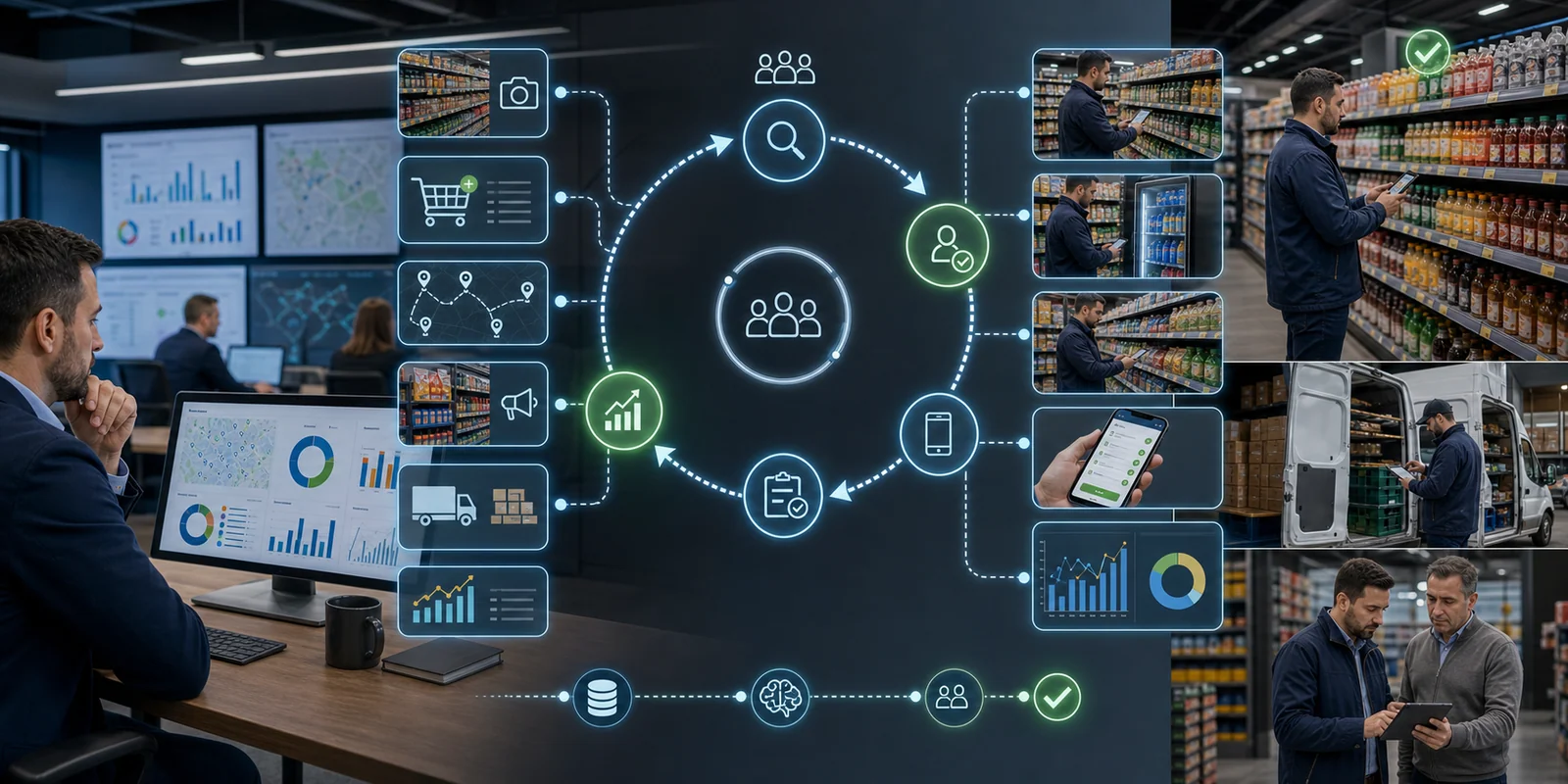
Many FMCG companies already have dashboards.
They have sales by channel, region, customer and SKU. They have OOS reports. They have visit maps. They have store photos. They have promo compliance. They have forecasts. They have BI screens that show what is happening.
And still, the problems remain.
The promotion is not executed. The shelf price is wrong. The cooler is in the wrong place. A key SKU is missing. The sales rep saw the issue, but it was never closed. The supervisor found out too late. Management sees the KPI drop, but does not know which concrete action will fix it.
This is the difference between reporting and execution.
A dashboard shows reality.
An execution loop changes it.
The dashboard shows, but does not fix
A dashboard is necessary.
Without it, the business runs on opinions. There is no shared view, no comparison across regions, no visibility into trends, and no fast way to see where performance is falling.
But the dashboard itself is not an action.
If a report shows that share of shelf dropped in 120 outlets, that is only a signal. If nobody receives a task, if there is no priority, no deadline, no proof of correction and no follow-up, the issue stays inside the analysis.
The same applies to:
- out-of-stock;
- wrong promotion price;
- missing POSM material;
- low visit coverage;
- weak recommended order acceptance rate;
- delayed delivery;
- unvalidated trade asset;
- missed secondary placement.
FMCG execution is won in the store, but many companies still manage it through reports after the event. That creates a delay between detecting the problem and closing it in the market.
What an execution loop means
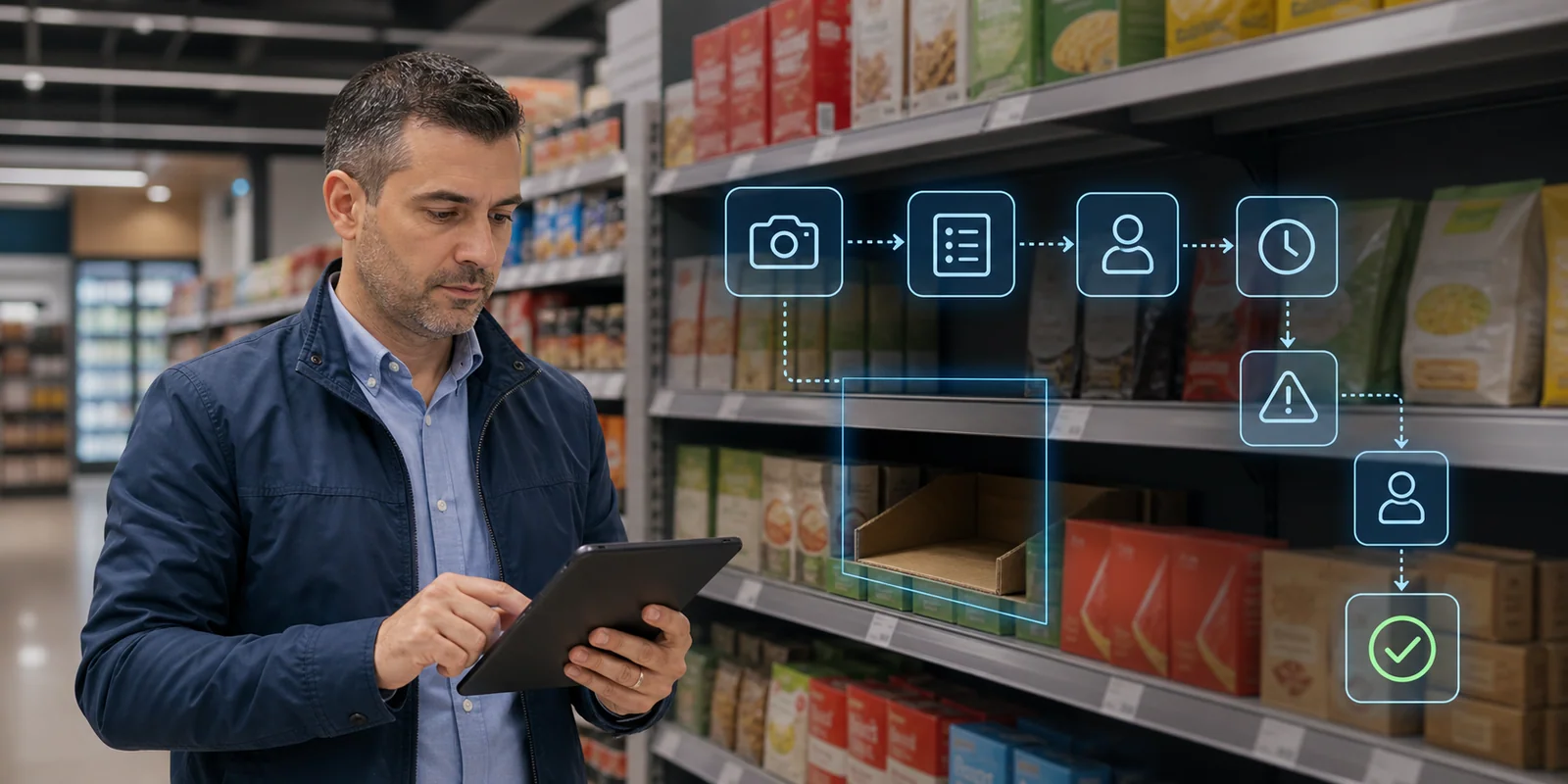
An execution loop is an operational cycle that turns a signal into a closed action.
The practical model is:
- Detect: the system identifies a problem or opportunity.
- Prioritize: the business value is evaluated.
- Assign: a task is created with an owner.
- Execute: a person or team performs the action.
- Verify: proof is collected.
- Measure: the effect is measured.
- Learn: rules, models and processes improve.
The framework is simple, but many organizations do not have the full cycle. They have detect and measure, but not assign, verify and learn.
That is where value leaks.
Example: out-of-stock on the shelf
Imagine image recognition detects OOS for a key SKU in a high-priority outlet.
A weak process looks like this:
- the photo enters a report;
- the dashboard shows OOS;
- someone sees it at the end of the day;
- the supervisor sends a message;
- the sales rep says they will check;
- nobody has clear proof of when the issue was closed.
A better execution loop looks like this:
- Image recognition detects the missing SKU with confidence;
- the system checks whether the SKU is strategic for that outlet;
- the DMS/ERP layer checks whether stock is available;
- AI Order Brain proposes a correction to the recommended order;
- Workflow orchestration creates a task for the responsible person;
- the task has a deadline, priority and reason code;
- the sales rep or merchandiser uploads a new photo;
- the system validates whether the shelf has been corrected;
- the dashboard measures closure rate and time-to-fix;
- the model learns which OOS signals most often lead to real action.
This is no longer reporting.
This is managed execution.
Example: promotion with a wrong price
Promotions are another classic case.
A dashboard can show that promo compliance is 74 percent in a region. That is useful, but not enough.
The business user needs to know:
- exactly which stores are problematic;
- whether the label is missing or the price is wrong;
- whether stock is available;
- which sales rep owns the outlet;
- whether the store manager was informed;
- whether the promotion can still be fixed before the weekend;
- whether there is before-and-after photo proof;
- whether sales improve after the correction.
Trade promotion execution is not only campaign planning. It is the process of closing deviations while the campaign can still be saved.
If the promotion issue is discovered after the period ends, the analysis may be correct, but the business value has already been missed.
Where dashboards fail
Dashboards fail not because they are bad, but because they are often treated as the final destination.
There are several common problems.
First, ownership is missing. The report shows the problem, but does not say who must solve it.
Second, workflow is missing. The data sits in BI, while tasks move through chat, email or verbal follow-up.
Third, prioritization is missing. Every problem looks important, so teams react to the loudest issue, not the most valuable one.
Fourth, proof is missing. The task is marked as done, but there is no photo, timestamp, GPS point, order correction or supervisor approval.
Fifth, learning is missing. The same problem repeats every week, but the system does not become smarter.
This is why BI without an execution layer often creates more visibility, but not necessarily better execution.
Owner, deadline and proof
An operational signal becomes a business action only when it has three things:
- owner;
- deadline;
- proof.
Owner means responsibility is not blurred across sales, trade marketing, distributor, logistics and supervisors.
Deadline means the problem does not wait for the weekly meeting.
Proof means closure is verifiable, not merely reported.
This is especially important in traditional trade, where the environment changes quickly, contacts rotate, stock moves fast and the number of outlets is large.
OptimaSale should be a field execution layer, not only a mobile form. OptimaCRM should make customer context and follow-up clear. OptimaDMS should connect stock, delivery and distributor execution.
When these layers are connected, the dashboard is no longer a separate screen. It becomes part of the execution cycle.
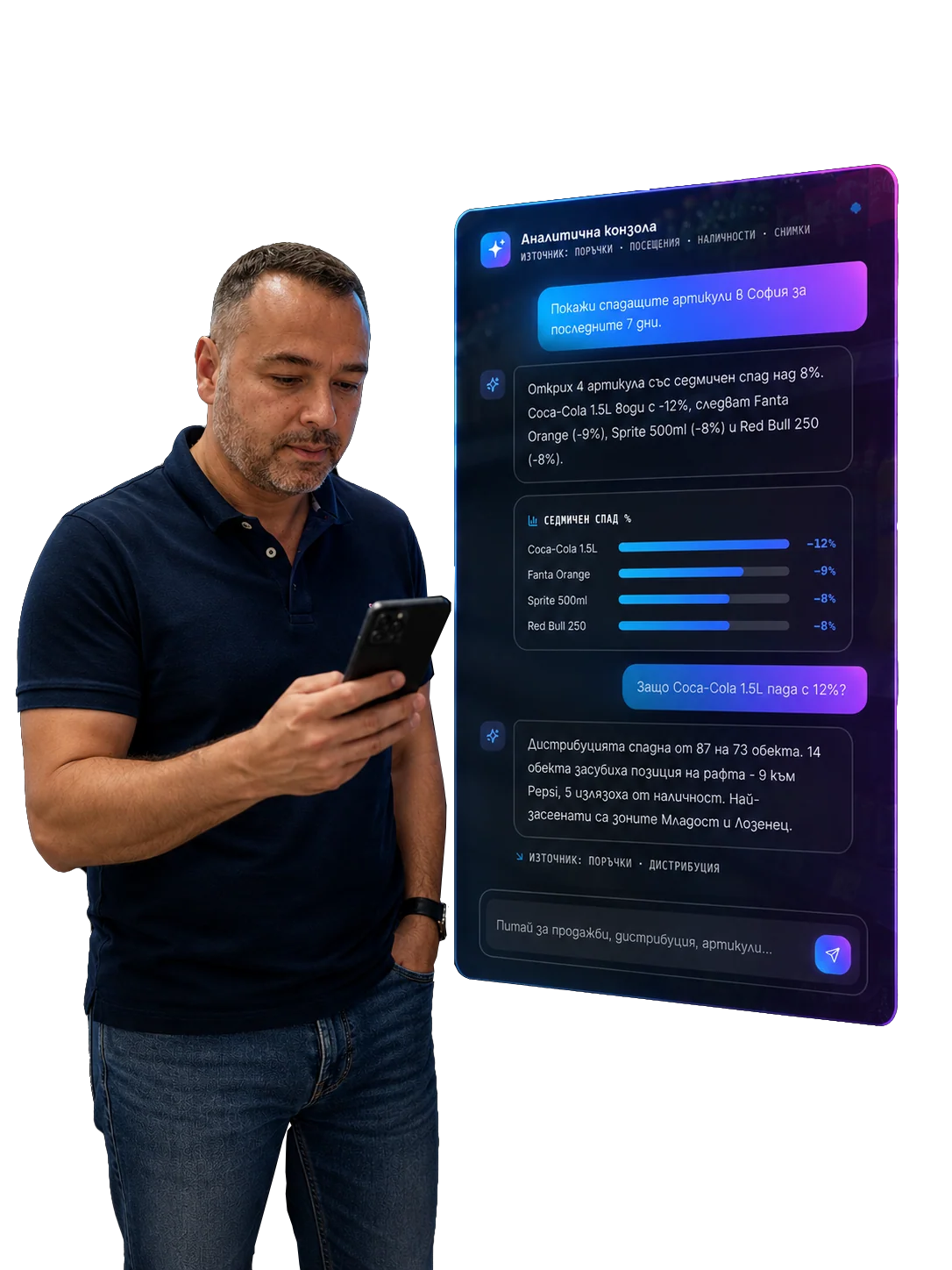
Chat BI without action is only faster questioning
Chat BI is valuable because it speeds up access to insight.
A manager can ask:
- "Which regions have the lowest promo compliance this week?"
- "Where is OOS repeating for the same SKU?"
- "Which sales reps have the highest number of rejected recommended orders?"
- "Which outlets have high sales potential but low shelf compliance?"
That is powerful.
But the next question matters more:
What do we do with the answer?
If Chat BI returns a list of 50 stores but cannot create tasks, suggest priority, identify the owner, open a workflow or track closure, it remains an analytical interface.
A better architecture connects Chat BI with the action layer.
The user should not only ask "where is the problem". They should be able to say "create an action plan for these 20 outlets, prioritize them by value and send the tasks to the right teams".
AI agents as execution assistants
AI agents make sense when they are not a demo, but part of a controlled process.
In FMCG, an agent can:
- group similar issues by root cause;
- suggest next-best-action;
- check stock before creating a task;
- prepare a supervisor briefing;
- detect recurring deviations;
- suggest a route priority change;
- remind people about unresolved issues;
- create a summary for the management meeting.
But the agent needs a framework:
- permission boundaries;
- audit log;
- human approval for sensitive actions;
- clear distinction between recommendation and decision;
- measurement of the effect.
Otherwise, an AI agent becomes another layer of noise.
Human-in-the-loop AI remains an important principle. The goal is not to remove people from the process. The goal is to remove manual search, copying and chasing from their day.
KPI for execution loops
If you want to manage execution loops, you need to measure more than detection rate.
| KPI | What it shows |
|---|---|
| Signal-to-task rate | How many detected issues become tasks |
| Time-to-assign | How quickly a signal receives an owner |
| Time-to-fix | How long it takes to correct the issue |
| Closure evidence rate | How many tasks include photo, order correction or other proof |
| Reopen rate | How many closed issues appear again |
| Business impact | Sales, availability, compliance or ROI after correction |
| Repeat issue rate | How often the same root cause repeats |
| Recommendation acceptance | How many AI recommendations are accepted and why they are changed |
These KPIs are more useful than pure reporting metrics because they show whether the organization is actually reacting.
Retail execution KPI should include not only the outcome, but also the speed of the management cycle.
How to start
You do not need to automate everything at once.
A better approach is to choose one concrete use case with clear value.
For example:
- OOS on the top 50 SKUs;
- promotion price compliance;
- cooler validation;
- secondary placements;
- recommended order corrections;
- high-potential outlets with low execution score.
Then define:
- Which signal starts the loop.
- How the signal is prioritized.
- Who owns it.
- Which action is expected.
- Which proof is accepted.
- Which KPI measures closure.
- How feedback improves the process.
This is more practical than a large BI program without operational adoption.
In short
The dashboard is important, but it is not enough.
FMCG execution requires a closed cycle:
- data detects the problem;
- the system prioritizes it;
- the task has an owner;
- the action has a deadline;
- closure has proof;
- the effect is measured;
- the process learns.
Companies that build this model will extract more value from BI, AI and image recognition. Companies that stay with reports only will know more about their problems, but will not necessarily solve them faster.
Related in Optimasoft
- Chat BI speeds up questions, but it should connect with the action layer.
- Workflow orchestration turns signals into owner, deadline and closure.
- AI agents can support next-best-action, prioritization and follow-up.
- Image recognition provides many of the shelf signals that start execution loops.
- AI Order Brain turns sales, stock and behavior data into recommended orders.
- Excel vs FMCG platform explains why spreadsheets are not enough for an execution system.
- How to choose an SFA platform in 2026 gives criteria for platform selection.
Sources
Related articles